Introduction
This Briefing Paper considers three countries that show emerging but very different shifts away from cigarettes: one incomplete, one stalled, and one accelerating.
Tobacco harm reduction (THR) is often discussed with reference to several notable countries where the uptake of different safer nicotine products (SNP) has coincided with rapid declines in combustible cigarette use. In Sweden and Norway, snus has largely replaced smoking, and Sweden is the only EU state to have reached ‘smoke-free status’, defined as less than 5% adult smoking prevalence. In Iceland, oral nicotine products and vaping have both expanded as smoking has fallen closer to that goal. The number of vapers has overtaken the number of people who smoke in both the United Kingdom and New Zealand, and following the arrival of heated tobacco products (HTP) in Japan, there was an unprecedented 50% drop in cigarette sales.[1,2,3,4,5] The GSTHR project has examined these pathways in earlier Briefing Papers. Canada and the United States also feature in wider THR discussions. Together, these countries all show how cigarette use can fall rapidly when non-combustible alternatives are adopted at scale.[6]
South Korea, Ireland and Estonia offer three less settled pathways to reduced smoking that merit analysis and observation
Beyond these better-known cases, however, South Korea, Ireland and Estonia offer three less settled pathways that merit analysis and observation: rapid HTP adoption but extensive poly-nicotine use in South Korea; established vaping alongside stalled smoking decline in Ireland; and, in Estonia, a sharp rise in vaping alongside accelerated smoking decline. This Briefing Paper compares these three trajectories and considers what they reveal about the conditions that support, stall or obstruct substitution away from cigarettes.
Why focus on emerging THR countries?
Population-level trends cannot prove that individuals are switching, and differences in survey design limit direct comparison between countries. Nevertheless, sustained movement in opposite directions – fewer people smoking and more using SNP – is an important signal of possible substitution and a reason to examine what helps or obstructs it.
Established THR cases often reflect distinctive histories, product cultures and rapid consumer adoption; only some, notably the United Kingdom and New Zealand, have also benefited from explicit policy support. The emerging cases examined here ask whether substantial movement away from cigarettes can develop even where governments remain neutral or precautionary.
sustained movement in opposite directions – fewer people smoking and more using SNP – is an important signal of possible substitution and a reason to examine what helps or obstructs it
None of the three countries analysed has a risk-proportionate THR strategy. Official messaging about SNP is generally cautious or skeptical, while regulation largely applies conventional tobacco control approaches to these products. Nevertheless, legal access and consumer demand have created space for measurable change. The comparison also shows that there is no universal substitute for cigarettes. South Korea is mainly an HTP market, while vaping is central in Ireland and Estonia. The route taken depends on product availability, price, culture, retail structure and consumer preference.

These are not the only emerging cases. For example, Switzerland and Belgium show a sustained rise in vaping alongside declining smoking; Czechia, Latvia and Lithuania show growth in both vaping and HTP use; and Greece, Slovakia, Portugal and Hungary show HTP-led patterns.[7] They are not examined here because the three selected countries provide the clearest contrasting trajectories, but for further detail and analysis of the wider patterns, see The Global State of Tobacco Harm Reduction 2026: A Situation Report.
there is no universal substitute for cigarettes – the route taken depends on product availability, price, culture, retail structure and consumer preference
South Korea: an HTP-led transition with growing poly-nicotine use
South Korea has recorded a major long-term decline in smoking. Adult prevalence fell from 35.1% in 1998 to 17.7% in 2022, while male smoking fell from 66.3% to 30.0%. Much of this progress preceded HTP, reflecting conventional tobacco control and changing social norms.[8]
A new phase began when HTP entered the market in 2017. By 2022, 5.9% of adults used HTP and 3.5% used nicotine vapes, while smoking had fallen from 22.3% in 2017 to 17.7% in 2022. The timing is consistent with renewed substitution, although more recent evidence complicates the picture.[9]

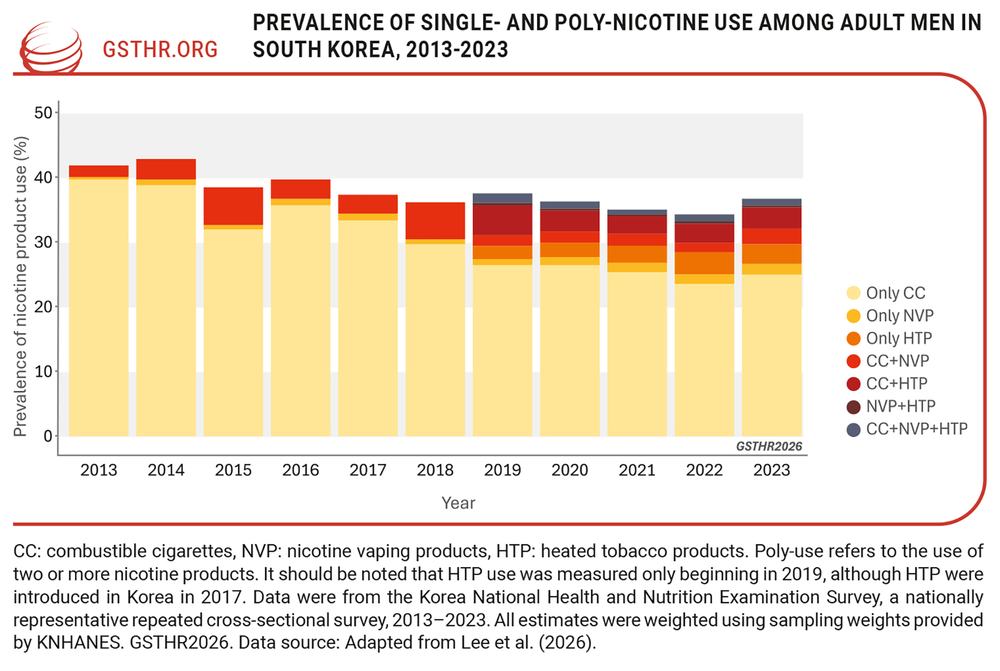
Among men, the overall use prevalence of any measured tobacco or nicotine products remained broadly stable between 2019 and 2023, while the composition of use changed. Exclusive cigarette smoking declined. Poly-nicotine use – the use of two or more nicotine products by an individual – accounted for a growing share of the nicotine market, rising from 1.8% in 2013 to 6.9% in 2023. Earlier research found that approximately 90% of HTP users also smoked cigarettes, used nicotine vapes or used all three products.[10,11] South Korea’s later transition therefore appears to be increasingly about changes in the mix of products used, rather than a further reduction in the overall prevalence of nicotine-product use.
Progress has also been highly unequal. Smoking remained concentrated among men with lower incomes, less education and manual occupations; among men living with severe mental illness, prevalence actually rose from 44.7% in 2013 to 47.2% in 2023.[12]
Figure 1
The reasons people in South Korea adopt HTP help explain why rapid uptake has not translated into complete switching. The leading reasons for regular HTP use were the products’ reduced smell in comparison to smoking cigarettes, cited by 71.3%, and a perception that HTP were less harmful than cigarettes, cited by 48.6%. However, only 35.4% of consumers who were using both HTP and cigarettes reported using HTP to quit smoking.[13] Product characteristics such as convenience, reduced smell and social acceptability can therefore drive substantial market growth without necessarily ending combustible use.
product characteristics such as convenience, reduced smell and social acceptability can drive substantial market growth without necessarily ending combustible use
The policy environment in South Korea provides only limited incentives for consumers to completely substitute combustible cigarettes with SNP. Taxes account for 73.8% of the retail price of cigarettes and 66.8% of the price of HTP, leaving a relatively modest fiscal advantage for switching.[14] To date, there is no coordinated public health strategy, nor explicit government endorsement of HTP as a harm reduction option, meaning the transition is largely dependent on consumer preferences.
South Korea shows both the disruptive potential and limitations of a consumer-driven transition. HTP gained substantial market share and coincided with a renewed decline in smoking, but the later growth of poly-nicotine use shows that market transformation does not automatically produce complete substitution. To realise tobacco harm reduction fully in South Korea, dual and multiple-product users should now be encouraged to stop smoking completely, with substantial reduction in smoking treated as an interim step, especially among groups who have benefited least from the national decline.
Ireland: an emerging transition that has stalled
Ireland combines strong conventional tobacco control with an increasingly restrictive approach to consumer nicotine products. Early progress in transitioning from combustible cigarettes to SNP has now stalled, and while the recent restrictions did not cause the original slowdown, they may impede further progress away from smoking.
Adult smoking prevalence fell rapidly from 23% in 2015 to 17% in 2019 but has remained broadly unchanged since then. In 2025, it was still 17% – far above the Tobacco Free Ireland target of reducing prevalence below 5% by that year. Smoking also remained substantially more common among men and adults with lower educational attainment, suggesting that conventional tobacco-control measures are delivering diminishing returns among the remaining population who smoke.[15,16]
Over the same period, vaping became an established part of Ireland’s nicotine market. Current use rose from 3% in 2015 to 5% in 2019, reached 8% in 2023 and remained at that level in 2024 and 2025. In 2025, half of current vapers formerly smoked, a pattern consistent with meaningful substitution, while one third continued to smoke, pointing to substantial dual use. Vaping has therefore become an important potential route away from cigarettes, although substitution has stalled.[17,18,19]
Figure 2
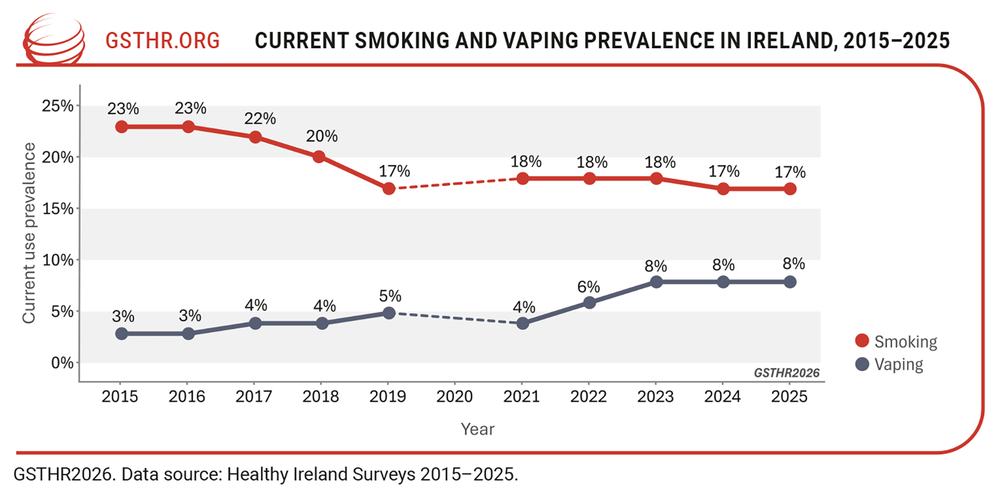
The loss of momentum is notable. Smoking declined while vaping expanded, and both trends later flattened. This does not prove that slower growth in vaping caused the smoking plateau: smoking had already levelled off before vaping stopped increasing, and population-level data cannot identify individual switching.
Ireland’s precautionary policy environment may now be reinforcing this stagnation. In 2025, 74% of adults believed vaping was as harmful as or more harmful than smoking, while only 11% considered it less harmful.[20] Misperceptions on this scale weaken the incentive for people who smoke to switch completely.
increasing prices and reducing the appeal and accessibility of alternatives could discourage substitution and prolong Ireland’s residual smoking burden
Policy has also become more restrictive. A tax of EUR 0.50 per millilitre of e-liquid took effect in November 2025.[21] If passed on to consumers in full, it could roughly triple the price of open-system e-liquid and increase the cost of pod consumables by around 40%, although vaping would remain considerably cheaper than smoking.[22] In March 2026, the government approved proposals to restrict advertising and retail displays, limit packaging and flavour descriptions, and make tobacco the default permitted flavour for nicotine-inhaling products.[23] These measures are intended to reduce youth uptake of vaping. But by increasing prices and reducing the appeal and accessibility of alternatives, they could discourage substitution and prolong Ireland’s residual smoking burden.
Importantly, recent youth data do not show the rise in smoking that might be expected under a simple ‘gateway hypothesis’ – the idea that vaping could make young people more likely to take up smoking. Among Irish students aged 15-16, current smoking fell from 14.4% in 2019 to 9% in 2024, while current vaping also declined from 21.5% to 18.1%.[24] Youth vaping remains a legitimate concern, but these trends do not support claims of a recent vaping-driven rebound in youth smoking. Youth protection and adult harm reduction can be pursued together: enforced age restrictions and responsible marketing controls need not prevent accurate comparative-risk communication or access to acceptable alternatives for adults who smoke.
Ireland is therefore neither an established THR success story nor does it provide evidence that vaping has failed. It is a transition that has lost momentum. Substitution away from combustibles is already notable, but future progress will depend on whether policy enables, rather than obstructs, that process. Risk-proportionate communication and regulation could help smoking resume its decline; an increasingly restrictive approach to safer alternatives, however, may prolong the current plateau.
risk-proportionate communication and regulation could help smoking resume its decline; an increasingly restrictive approach to safer alternatives, however, may prolong the current plateau
Estonia: the clearest new trajectory
Among the three countries examined here, Estonia provides the clearest evidence of an emerging THR transition. Its trajectory is especially striking because the most rapid change occurred only after 2020, when a gradual decline in smoking gave way to a much sharper shift.
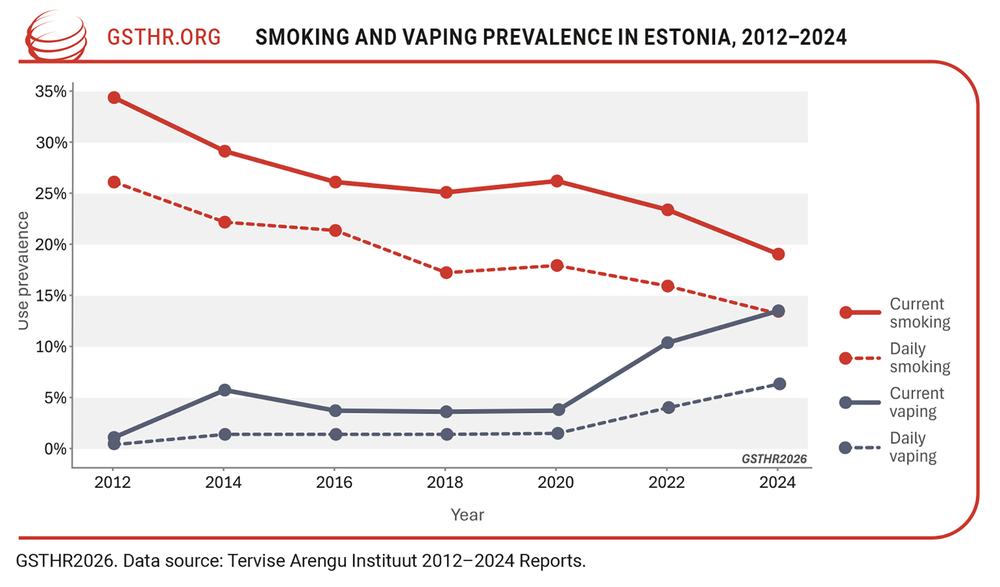
Current smoking fell from 34.2% in 2012 to 25.0% in 2018, before increasing slightly to 26.1% in 2020. Over the next four years, however, it dropped sharply to 19.0%. Daily smoking followed the same pattern, falling from 17.9% in 2020 to 13.2% in 2024. At the same time, current vaping more than tripled, from 3.8% to 13.5%, while daily vaping increased fourfold, from 1.6% to 6.4%. By 2024, daily vaping prevalence was approaching half the level of daily smoking. Nicotine pouches and HTP had also become visible in the market, although at lower levels: 2.8% of adults used nicotine pouches daily and 1.2% used HTP daily.[25]
What makes the Estonian pattern particularly compelling is that the shift is visible in both current and daily use. Smoking declined on both measures, while vaping increased on both. This makes it less likely that the trend reflects only occasional experimentation. Between 2020 and 2024, current smoking fell by 7.1 percentage points while current vaping rose by 9.7 points. Aggregate data cannot prove that the same individuals switched, and some people undoubtedly use both products. Even so, the simultaneous acceleration in smoking decline and vaping uptake provides one of Europe’s strongest descriptive signals of possible substitution.
the simultaneous acceleration in smoking decline and vaping uptake provides one of Europe’s strongest descriptive signals of possible substitution
Figure 3
Estonia has not formally endorsed THR. Its regulatory framework reflects the precautionary approach common across the European Union, including restrictions on advertising, flavours, distance sales and use in public places. Yet nicotine vapes and other non-combustible alternatives have remained legally available. Estonia has therefore offered a powerful example of how a consumer-led transition can develop without explicit government support, provided that safer alternatives remain sufficiently accessible and acceptable.[26]
However, this trajectory may now face a significant policy test. In July 2026, Estonia opened a consultation on draft amendments that would effectively restrict e-liquid flavour profiles to tobacco and menthol, cap nicotine content in pouches and other products at 4 mg/g and ban domestic and cross-border distance sales.[27] Although intended to protect young people, these restrictions could reduce the appeal, effectiveness and accessibility of legal alternatives for adults who smoke. Evidence from US flavour restrictions suggests that such measures can reduce vaping across all age groups, while producing unintended increases in cigarette smoking among some younger adults.[28,29]
Future survey waves will therefore be particularly important in showing whether Estonia continues towards lower smoking prevalence or whether increasingly restrictive regulation interrupts one of Europe’s clearest emerging THR transitions.
Estonia has offered a powerful example of how a consumer-led transition can develop without explicit government support, provided that safer alternatives remain sufficiently accessible and acceptable
Conclusion: what do these three case studies tell us about THR’s future?
South Korea, Ireland and Estonia are transitions in progress, not finished success stories. Considering their national trajectories of tobacco and nicotine product use offers a number of insights into how THR may play out in different countries. Firstly, these countries confirm that substitution can begin without explicit government endorsement of THR. Legal availability, product acceptability and consumer demand can be sufficient to begin a transition away from cigarettes – it is when determining whether that transition remains partial and uneven, or develops into rapid, complete and equitable switching, that policy becomes crucial.
Secondly, the route away from smoking also differs by market. HTP use dominates in South Korea, coexisting with persistent cigarette smoking and growing use of multiple products. Meanwhile vaping plays the central role in Ireland and Estonia. Which products lead depends on availability, price, culture, retail structure and, crucially, consumer preference. Regulation that supports only one type of safer nicotine product will fail to reflect how people actually behave and may limit harm reduction’s potential.
South Korea, Ireland and Estonia confirm that substitution can begin without explicit government endorsement of THR; legal availability, product acceptability and consumer demand can be sufficient to begin a transition away from cigarettes
Accurate risk communication is also vital. When adults believe, for example, that vaping is as harmful as smoking, they have little incentive to switch. Public health communication should make clear that safer nicotine products are not risk-free, but that continued smoking is substantially more dangerous. Youth protection and adult harm reduction should not be treated as competing objectives. Governments can enforce age restrictions and limit youth-oriented promotion while preserving affordable, acceptable and accessible alternatives for adults who smoke. New taxes and product restrictions should therefore be assessed not only for their intended effects, but also for their impact on smoking rates, complete switching, relapse from SNP to smoking, health inequalities and the growth of illicit markets.
regulation that supports only one type of safer nicotine product will fail to reflect how people actually behave and may limit harm reduction’s potential
Ultimately, success should not be measured by uptake of safer nicotine products alone, but by how quickly and equitably cigarette smoking declines, how many people switch completely, and whether those changes are sustained. A policy environment that makes the safer choice easier rather than harder is essential to realising the full potential of tobacco harm reduction.
a policy environment that makes the safer choice easier rather than harder is essential to realising the full potential of tobacco harm reduction
For further information about the Global State of Tobacco Harm Reduction’s work, or the points raised in this GSTHR Briefing Paper, please contact [email protected]
About us: Knowledge•Action•Change (K•A•C) promotes harm reduction as a key public health strategy grounded in human rights. The team has over forty years of experience of harm reduction work in drug use, HIV, smoking, sexual health, and prisons. K•A•C runs the Global State of Tobacco Harm Reduction (GSTHR) which maps the development of tobacco harm reduction and the use, availability and regulatory responses to safer nicotine products, as well as smoking prevalence and related mortality, in over 200 countries and regions around the world. For all publications and live data, visit https://gsthr.org
Our funding: The GSTHR project is produced with the help of a grant from Global Action to End Smoking (“Global Action”), a US nonprofit 501(c)(3) private foundation, accelerating science-based efforts worldwide to end the smoking epidemic. Global Action had no role in designing, implementing, data analysis, or interpretation of this Briefing Paper. The contents, selection and presentation of facts, as well as any opinions expressed herein, are the sole responsibility of the authors and under no circumstances should they be regarded as reflecting the positions of Global Action.
[1] How snus is replacing smoking in Norway: A revolution led by consumers and product innovation (Briefing Papers). (2025). Global State of Tobacco Harm Reduction (GSTHR). https://gsthr.org/resources/briefing-papers/how-snus-is-replacing-smoking-in-norway-a-revolution-led-by-consumers-and-product-innovation/how-snus-is-replacing-smoking-in-norway-a-revolution-led-by-consumers-and-product-innovation/.
[2] Porritt, O. (2025b). From cigarettes to snuff to nicotine pouches: The unusual Icelandic model for tobacco harm reduction (GSTHR Briefing Papers). Global State of Tobacco Harm Reduction. https://gsthr.org/briefing-papers/from-cigarettes-to-snuff-to-nicotine-pouches-the-unusual-icelandic-model-for-tobacco-harm-reduction/.
[3] GSTHR. (2024a). A smokefree UK? How research, policy and vapes have cut smoking rates (Briefing Papers). Global State of Tobacco Harm Reduction (GSTHR). https://gsthr.org/resources/briefing-papers/a-smokefree-uk-how-research-policy-and-vapes-have-cut-smoking-rates/a-smokefree-uk-how-research-policy-and-vapes-have-cut-smoking-rates/.
[4] GSTHR. (2024b). Pro-consumer laws and an endorsement for vaping: Why smoking is disappearing in Aotearoa New Zealand (Briefing Papers). Global State of Tobacco Harm Reduction (GSTHR). https://gsthr.org/resources/briefing-papers/pro-consumer-laws-and-an-endorsement-for-vaping-why-smoking-is-disappearing-in-aotearoa-new-zealand/pro-consumer-laws-and-an-endorsement-for-vaping-why-smoking-is-disappearing-in-aotearoa-new-zealand/.
[5] Porritt, O. (2025a). Why is tobacco harm reduction needed and what is the evidence it works? (GSTHR Briefing Papers). Global State of Tobacco Harm Reduction (GSTHR). https://gsthr.org/resources/briefing-papers/why-is-tobacco-harm-reduction-needed-and-what-is-the-evidence-it-works/.
[6] Shapiro, H., & Mzhavanadze, G. (2026). The Global State of Tobacco Harm Reduction 2026: A Situation Report (No. 5; GSTHR Major Reports). Global State of Tobacco Harm Reduction (GSTHR).https://gsthr.org/resources/thr-reports/the-global-state-of-tobacco-harm-reduction-2026-a-situation-report/.
[7] Shapiro & Mzhavanadze, 2026.
[8] Park, J. E., Jeong, W. M., Choi, Y. J., Kim, S. Y., Yeob, K. E., & Park, J. H. (2024). Tobacco Use in Korea: Current Epidemiology and Public Health Issues. Journal of Korean Medical Science, 39(45), e328. https://doi.org/10.3346/jkms.2024.39.e328.
[9] Park, Jeong, Choi, Kim, Yeob, & Park, 2024.
[10] Lee, B., Kwon, M., Park, A.-H., & Kim, H. (2026). Tobacco use trends in South Korea, 2013–2023: Persistent disparities and emerging challenges in a repeated cross-sectional study. Tobacco Induced Diseases, 24(February), 1–11. https://doi.org/10.18332/tid/215655.
[11] Kim, S. H., & Cho, H.-J. (2020). Prevalence and correlates of current use of heated tobacco products among a nationally representative sample of Korean adults: Results from a cross-sectional study. Tobacco Induced Diseases, 18(August). https://doi.org/10.18332/tid/125232.
[12] Lee, Kwon, Park, & Kim, 2026.
[13] Seo, H. G., Xu, S. S., Li, G., Gravely, S., Quah, A. C. K., Lee, S., Lim, S., Cho, S., Kim, Y., Lee, E. S., Choi, Y.-J., Miller, C. R., Goniewicz, M. L., O’Connor, R. J., & Fong, G. T. (2023). Reasons for Initiation and Regular Use of Heated Tobacco Products among Current and Former Smokers in South Korea: Findings from the 2020 ITC Korea Survey. International Journal of Environmental Research and Public Health, 20(6), 4963. https://doi.org/10.3390/ijerph20064963.
[14] WHO. (2026). Tobacco MPOWER Raise taxes: Tobacco and nicotine products national taxes. The Global Health Observatory. https://www.who.int/data/gho/data/indicators/indicator-details/GHO/tobacco-raise-taxes--national-taxes-for-and-nicotine-products.
[15] Healthy Ireland; Department of Health. (2026a). Healthy Ireland Survey. Publications. Healthy Ireland Surveys 2015-2025. Gov.Ie; Government of Ireland. https://www.gov.ie/en/healthy-ireland/publications/healthy-ireland-survey-2025/.
[16] Healthy Ireland; Department of Health. (2026b, July 20). Healthy Ireland Policies. Gov.Ie; Government of Ireland. https://www.gov.ie/en/healthy-ireland/policy-information/healthy-ireland-policies/.
[17] Healthy Ireland; Department of Health, 2026a.
[18] Healthy Ireland; Department of Health, 2026b.
[19] Brennan, M. M., Bowe, A. K., Sheridan, A., Doyle, F., Boland, F., & Kavanagh, P. (2025). Evolution of nicotine product use in Ireland 2015–2023, and associations with quit intentions and attempts: An analysis of nationally representative repeated cross-sectional surveys. The Lancet Regional Health – Europe, 55. https://doi.org/10.1016/j.lanepe.2025.101352.
[20] Healthy Ireland; Department of Health, 2026a.
[21] Revenue publishes guidance on new ‘Vape Tax’. (2025, September 30). Revenue. Cáin Agus Custaim Na hÉireann. Trish Tax and Customs. https://www.revenue.ie/en/corporate/press-office/press-releases/2025/pr-093025-vape-tax.aspx.
[22] Shapiro & Mzhavanadze, 2026.
[23] Department of Health. (2026, March 4). Ministers announce Government approval of proposals for further regulation of nicotine products. Gov.Ie; Government of Ireland. https://www.gov.ie/en/department-of-health/press-releases/ministers-announce-government-approval-of-proposals-for-further-regulation-of-nicotine-products/.
[24] European Union Drugs Agency. (2025). Key findings from the 2024 European school survey project on alcohol and other drugs (ESPAD). Publications Office. https://data.europa.eu/doi/10.2810/5746644.
[25] Reile, R., Põlajev, A., & Saavaste, J. (2025). Eesti täiskasvanud rahvastiku tervisekäitumise uuring 2024: Metoodika ja standardtabelite kogumik [Health behaviour among the Estonian adult population 2024: Methodology and standard tables] (No. 978-9949-666-68–3). Tervise Arengu Instituut. https://tai.ee/sites/default/files/2025-04/tku2024_kogumik_29apr2025_final.pdf.
[26] E-cigarette vaping in Estonia. (2026). Global State of Tobacco Harm Reduction. https://gsthr.org/countries/profile/est/e_cigarettes/.
[27] Justiits- ja Digiministeerium. (2026, July 17). Tubakaseaduse ja riigilõivuseaduse muutmise seaduse eelnõu esitamine kooskõlastamiseks ja arvamuse avaldamiseks Draft Act amending the Tobacco Act and the State Fees Act, File No. 26-0826 [8-1/5425-1]. Eelnõude infosüsteem (EIS); Justiits- ja Digiministeerium. https://eelnoud.valitsus.ee/main/mount/docList/c5556638-5d38-467f-bd6d-e3c16ad59fda#c8z7oFXU.
[28] Friedman, A. S., Pesko, M. F., & Whitacre, T. R. (2024). Flavored E-Cigarette Sales Restrictions and Young Adult Tobacco Use. JAMA Health Forum, 5(12), e244594. https://doi.org/10.1001/jamahealthforum.2024.4594.
[29] Saffer, H., Ozdogan, S., Grossman, M., Dench, D., & Dave, D. (2025). Comprehensive E-Cigarette Flavor Bans and Tobacco Use Among Youth and Adults. Health Economics, 34(12), 2238–2254. https://doi.org/10.1002/hec.70030.
Images: depositphotos.com