

In France, e-cigarettes are allowed and regulated both as consumer products and as medicinal products. Online sales of e-cigarettes are permitted, and they are widely available in general retail outlets. However, health claims promoting e-cigarettes are not allowed, and there is a complete ban on all forms of advertising. Unlike some other European countries, France does not currently impose an excise tax on e-cigarette products. The country has a comprehensive regulatory framework governing e-cigarette manufacture and sale. Under these regulations, product notifications are required prior to market entry, and child-resistant and tamper-proof containers are mandatory. Health warnings must be clearly displayed on all packaging. Additionally, sales are restricted to individuals aged 18 years and above, and the maximum nicotine concentration is limited to 20 mg/ml. There are also tank capacity restrictions (2 ml or less) in line with European Union regulations. France does not impose flavour restrictions, but the use of e-cigarettes is prohibited in certain public places.
As of 2021, France recorded approximately 3 million current vapers. The adult current vaping prevalence was 8.3% in 2023 and daily vaping prevalence was 4.6% in 2022 (2.5 million daily vapers). Survey data from 2017 show that 24% of adults reported having tried e-cigarette vaping at least once. Public perception data collected in 2017 indicate that 62% of respondents viewed e-cigarettes as harmful or more harmful than traditional cigarettes, while 21% believed they were less harmful, and 17% were unsure.
Prevalence
| Year | Value | Reference/Comment |
|---|---|---|
| 2017 | 4% | 2A A |
| 2021 | 5.59% | 2B |
| 2022 | 7% | 2C |
| 2022 | 6.7% | 2D B |
| 2023 | 8.3% | 2E |
- 1. European Commission (2017). Special Eurobarometer 458: Attitudes of Europeans towards tobacco and electronic cigarettes Available at: http://data.europa.eu/euodp/en/data/dataset/S2146_87_1_458_ENG ; 2. Pasquereau, A. et al, (2018) La consommation de tabac en France: premiers r�sultats du barometre sant� 2017. Bull �pid�miol hebd, 2018: p. 14-15.
- European Commission. (2021). Special Eurobarometer 506: Attitudes of Europeans towards tobacco and electronic cigarettes (S2240_506_ENG). European Commission. http://data.europa.eu/88u/dataset/S2240_506_ENG
- European Commission. (2024). Special Eurobarometer 539: Attitudes of Europeans towards tobacco and related products [Dataset]. European Commission. https://europa.eu/eurobarometer/surveys/detail/2995
- WHO. WHO report on the global tobacco epidemic, 2023. Available at: https://cdn.who.int/media/docs/default-source/country-profiles/tobacco/gtcr-2023/tobacco-2023-fra.pdf?sfvrsn=b4395f6_3&download=true. Accessed: 6 August 2025.
- l’Enquête sur les représentations, opinions et perceptions sur les psychotropes (EROPP) 2023 cited in WHO. (2025). WHO global report on trends in prevalence of tobacco use 2000–2024 and projections 2025–2030 (6th edn). World Health Organization. https://www.who.int/publications/i/item/9789240116276
- Eurobarometer data provides a representative sample of ~28,000 respondents and estimates the prevalence of vaping for the EU overall, as well as per country. The survey was conducted in March 2017. Covers 28 European Union (EU) countries. Total sample N = 27901, aged 15 and over. nb In country survey using 2017 Health Barometer data shows a significant difference in 'ever tried' vaping (41.7%) Ref: Pasquereau et al (2018)
- Adults survey: Baromètre santé, 2021; National, ages 18-75
| Year | Value | Reference/Comment |
|---|---|---|
| 2022 | 2.7 million | 3A A |
| 2022 | 2.5 million | 3B B |
- 1. WHO. WHO report on the global tobacco epidemic, 2023. Available at: https://cdn.who.int/media/docs/default-source/country-profiles/tobacco/gtcr-2023/tobacco-2023-fra.pdf?sfvrsn=b4395f6_3&download=true. Accessed: 6 August 2025. 2. Calculation based on population size data of people over 15 years of age (16+). Source of population data: World Population Prospects 2019 [Internet]. United Nations; 2019. (Department of Economic and Social Affairs, editor. Population Division). Report No.: Rev. 1. Available from: https://population.un.org/wpp/Download/Standard/Population/
- 1. European Commission. (2024). Special Eurobarometer 539: Attitudes of Europeans towards tobacco and related products [Dataset]. European Commission. https://europa.eu/eurobarometer/surveys/detail/2995 2. Calculation based on population size data of people over 15 years of age (16+). Source of population data: World Population Prospects 2019 [Internet]. United Nations; 2019. (Department of Economic and Social Affairs, editor. Population Division). Report No.: Rev. 1. Available from: https://population.un.org/wpp/Download/Standard/Population/
- Adults survey: Baromètre santé, 2021; National, ages 18-75 World Population Prospects 2019 [Internet]. United Nations; 2019. (Department of Economic and Social Affairs, editor. Population Division). Report No.: Rev. 1. Available from: https://population.un.org/wpp/Download/Standard/Population/
- E-cigarettes with nicotine World Population Prospects 2019 [Internet]. United Nations; 2019. (Department of Economic and Social Affairs, editor. Population Division). Report No.: Rev. 1. Available from: https://population.un.org/wpp/Download/Standard/Population/
| Year | Value | Reference/Comment |
|---|---|---|
| 2022 | 5% | 4A A |
| 2022 | 4.6% | 4B B |
- WHO. WHO report on the global tobacco epidemic, 2023. Available at: https://cdn.who.int/media/docs/default-source/country-profiles/tobacco/gtcr-2023/tobacco-2023-fra.pdf?sfvrsn=b4395f6_3&download=true. Accessed: 6 August 2025.
- European Commission. (2024). Special Eurobarometer 539: Attitudes of Europeans towards tobacco and related products [Dataset]. European Commission. https://europa.eu/eurobarometer/surveys/detail/2995
- Adults survey: Baromètre santé, 2021; National, ages 18-75
- E-cigarettes with nicotine
- European Commission. (2021). Special Eurobarometer 506: Attitudes of Europeans towards tobacco and electronic cigarettes (S2240_506_ENG). European Commission. http://data.europa.eu/88u/dataset/S2240_506_ENG
- l’Enquête sur les représentations, opinions et perceptions sur les psychotropes (EROPP) 2023 cited in WHO. (2025). WHO global report on trends in prevalence of tobacco use 2000–2024 and projections 2025–2030 (6th edn). World Health Organization. https://www.who.int/publications/i/item/9789240116276
- 1. European Commission. (2024). Special Eurobarometer 539: Attitudes of Europeans towards tobacco and related products [Dataset]. European Commission. https://europa.eu/eurobarometer/surveys/detail/2995 2. Calculation based on population size data of people over 15 years of age (16+). Source of population data: World Population Prospects 2019 [Internet]. United Nations; 2019. (Department of Economic and Social Affairs, editor. Population Division). Report No.: Rev. 1. Available from: https://population.un.org/wpp/Download/Standard/Population/
- European Commission. (2024). Special Eurobarometer 539: Attitudes of Europeans towards tobacco and related products [Dataset]. European Commission. https://europa.eu/eurobarometer/surveys/detail/2995
- 1. European Commission (2017). Special Eurobarometer 458: Attitudes of Europeans towards tobacco and electronic cigarettes Available at: http://data.europa.eu/euodp/en/data/dataset/S2146_87_1_458_ENG ; 2. Pasquereau, A. et al, (2018) La consommation de tabac en France: premiers r�sultats du barometre sant� 2017. Bull �pid�miol hebd, 2018: p. 14-15.
- E-cigarettes with nicotine World Population Prospects 2019 [Internet]. United Nations; 2019. (Department of Economic and Social Affairs, editor. Population Division). Report No.: Rev. 1. Available from: https://population.un.org/wpp/Download/Standard/Population/
- E-cigarettes with nicotine
- Eurobarometer data provides a representative sample of ~28,000 respondents and estimates the prevalence of vaping for the EU overall, as well as per country. The survey was conducted in March 2017. Covers 28 European Union (EU) countries. Total sample N = 27901, aged 15 and over. nb In country survey using 2017 Health Barometer data shows a significant difference in 'ever tried' vaping (41.7%) Ref: Pasquereau et al (2018)
Product promotion
- Anti Smoking Global Index. Vaping Products. Available at: https://antismoking.global/world-map. Accessed: 22 July 2025.
- Global Tobacco Control. Country Laws Regulating E-Cigarettes. Available at: https://www.globaltobaccocontrol.org/en/policy-scan/e-cigarettes/countries?country=85. Accessed: 24 July 2025.
- Allowed or banned at place of sale or allowed or banned in all media.
Regulation
| Year | Value | Reference/Comment |
|---|---|---|
| 2017 or earlier | Allowed | 1A |
| 2024 | Allowed | 1B |
- Data cross-referenced where possible using the following sources :1. Vapetrotter website. Available at: https://www.vapetrotter.com/laws/ ; 2. Global tobacco control website. Available at:https://www.globaltobaccocontrol.org/node/14052 ; 3. Tobacco Control Laws website. Available at : https://www.tobaccocontrollaws.org/legislation/
- Anti Smoking Global Index. Vaping Products. Available at: https://antismoking.global/world-map. Accessed: 22 July 2025.
| Year | Value | Reference/Comment |
|---|---|---|
| 2017 or earlier | Yes | 2A |
| 2022 | Yes | 2B |
- Data cross-referenced where possible using the following sources :1. Vapetrotter website. Available at: https://www.vapetrotter.com/laws/ ; 2. Global tobacco control website. Available at:https://www.globaltobaccocontrol.org/node/14052 ; 3. Tobacco Control Laws website. Available at : https://www.tobaccocontrollaws.org/legislation/
- Global Tobacco Control. Country Laws Regulating E-Cigarettes. Available at: https://www.globaltobaccocontrol.org/en/policy-scan/e-cigarettes/countries?country=85. Accessed: 24 July 2025.
| Year | Value | Reference/Comment |
|---|---|---|
| 2017 or earlier | Yes | 2A |
| 2022 | Yes | 2B |
- Data cross-referenced where possible using the following sources :1. Vapetrotter website. Available at: https://www.vapetrotter.com/laws/ ; 2. Global tobacco control website. Available at:https://www.globaltobaccocontrol.org/node/14052 ; 3. Tobacco Control Laws website. Available at : https://www.tobaccocontrollaws.org/legislation/
- Global Tobacco Control. Country Laws Regulating E-Cigarettes. Available at: https://www.globaltobaccocontrol.org/en/policy-scan/e-cigarettes/countries?country=85. Accessed: 24 July 2025.
- Anti Smoking Global Index. Vaping Products. Available at: https://antismoking.global/world-map. Accessed: 22 July 2025.
- Global Tobacco Control. Country Laws Regulating E-Cigarettes. Available at: https://www.globaltobaccocontrol.org/en/policy-scan/e-cigarettes/countries?country=85. Accessed: 24 July 2025.
- Data cross-referenced where possible using the following sources :1. Vapetrotter website. Available at: https://www.vapetrotter.com/laws/ ; 2. Global tobacco control website. Available at:https://www.globaltobaccocontrol.org/node/14052 ; 3. Tobacco Control Laws website. Available at : https://www.tobaccocontrollaws.org/legislation/
Availability
- Anti Smoking Global Index. Vaping Products. Available at: https://antismoking.global/world-map. Accessed: 22 July 2025.
Regulations and restrictions
- Global Tobacco Control. Country Laws Regulating E-Cigarettes. Available at: https://www.globaltobaccocontrol.org/en/policy-scan/e-cigarettes/countries?country=85. Accessed: 24 July 2025.
- Anti Smoking Global Index. Vaping Products. Available at: https://antismoking.global/world-map. Accessed: 22 July 2025.
- https://ec.europa.eu/health/tobacco/products/revision_en
- Text health warnings : “La nicotine contenue dans ce produit crée une forte dépendance. Son utilisation par les non-fumeurs n’est pas recommandée” (“This product contains nicotine which is a highly addictive substance. It is not recommended for use by nonsmokers”) .
- Ingredients/ flavours should not be harmful to health.
Perception of harm
- Reference: European Commission (2017). Special Eurobarometer 458: Attitudes of Europeans towards tobacco and electronic cigarettes Available at: http://data.europa.eu/euodp/en/data/dataset/S2146_87_1_458_ENG
- Question asked in this survey did not compare harmfulness with cigarettes. The question used was 'Do you think they are harmful to the health of people who use them?' 62% - YES, 21% - NO, 17% DON'T KNOW
Tax
- Anti Smoking Global Index. Vaping Products. Available at: https://antismoking.global/world-map. Accessed: 22 July 2025.
Publications

Prevalence of Current Smoking Cigarettes and Current Vaping
- Burning Issues: The Global State of Tobacco Harm Reduction 2020
Overall, as a percentage of the total adult population, current use of vaping devices in different countries ranges between 1% and 7%. As shown by this graphic there are eight countries where the prevalence of vaping is 3% or more including the UK, United Arab Emirates (UAE), US, France, Iceland, Belgium, the Russian Federation and Malaysia. The average prevalence of current vaping product use is 1.6 % of the adult population in the EU, as found in the EU Eurobarometer survey. A further 13% “used to use them, but no longer do so” or “have tried them once or twice”. 85.6% “have never tried or used them”. Levels of sometime vaping experience range up to 27% of the adult population in Greece, and 20% or above in Estonia, Czech Republic, France, Cyprus, Latvia and Austria. Clearly, there are many smokers who are interested in these products. But there is also a large gap between those who have shown enough interest to have tried vaping at some time, and those who have gone on to currently vape.
See also p.50 of the report: Burning Issues: The Global State of Tobacco Harm Reduction 2020


The European Union (EU) Tobacco Products Directive (TPD) 2016 Changes to the EU TPD
- No Fire, No Smoke: The Global State of Tobacco Harm Reduction
The TPD is a Directive of the EU which means that all EU countries must ‘transpose’ or incorporate the TPD requirements into their national laws. The only flexibility permitted is the ability to enact additional regulations. The current Directive entered into force on 19th May 2014 and became applicable in the EU Member States on 20th May 2016.
In 2014 a revised Tobacco Products Directive known as TPD 2 was issued by the EU to update the 2001 Tobacco Products Directive. TPD2 regulates all tobacco products in the European Union and its scope is wide. It covers product regulation in terms of reporting obligations of ingredients and emissions for all tobacco products. It includes product packaging and labelling including the size and appearance of products, traceability features to be fixed onto packaging as well as health warnings. It covers cross-border advertising of tobacco products; it reinforces the ban on oral tobacco products (snus), but importantly it provides for the placing on the market of e-cigarettes and refill containers, as well as making provision for notification of novel tobacco products. It also provides for herbal cigarettes.
See also p. 96 of the report: No Fire, No Smoke: The Global State of Tobacco Harm Reduction 2018 — Global State of Tobacco Harm Reduction (gsthr.org)
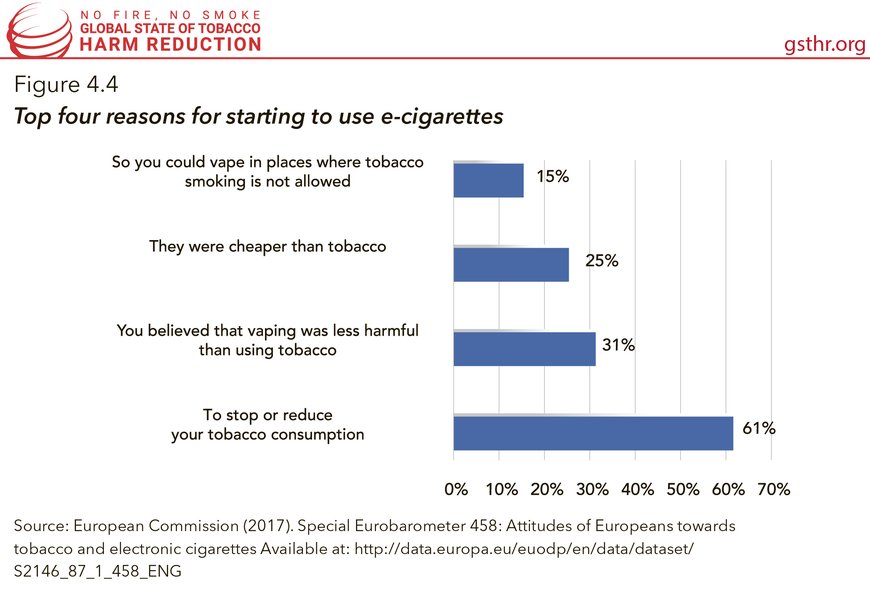
Top Four Reasons for Starting to Use E-Cigarettes
- No Fire, No Smoke: The Global State of Tobacco Harm Reduction
This figure illustrates the most important reasons that motivate smokers to switch to e-cigarettes, across the 28 member states of the European Union in 2017.
The top reason across the EU for using e-cigarettes is to stop using tobacco. The clear majority of people using e-cigarettes did so to stop, or to reduce tobacco use (61%). Following this the next reason was because they thought e-cigarettes were less harmful than cigarettes (31%), or less expensive (25%). Only 6% said they started because they felt using e-cigarettes was cool or attractive.
See also p. 44 of the report: No Fire, No Smoke: The Global State of Tobacco Harm Reduction 2018 — Global State of Tobacco Harm Reduction (gsthr.org)