Introduction
Heated tobacco products are a non-combustible safer nicotine product that use an electronic heating element to heat sticks of tobacco, producing a nicotine vapour that is then inhaled. Also known as heat-not-burn products, they first came to market in the mid-2010s and include brands such as IQOS, glo and Ploom. This Briefing Paper provides an introduction to the heated tobacco product category and explores their tobacco harm reduction potential.
How do they differ from combustible tobacco products and who makes them?
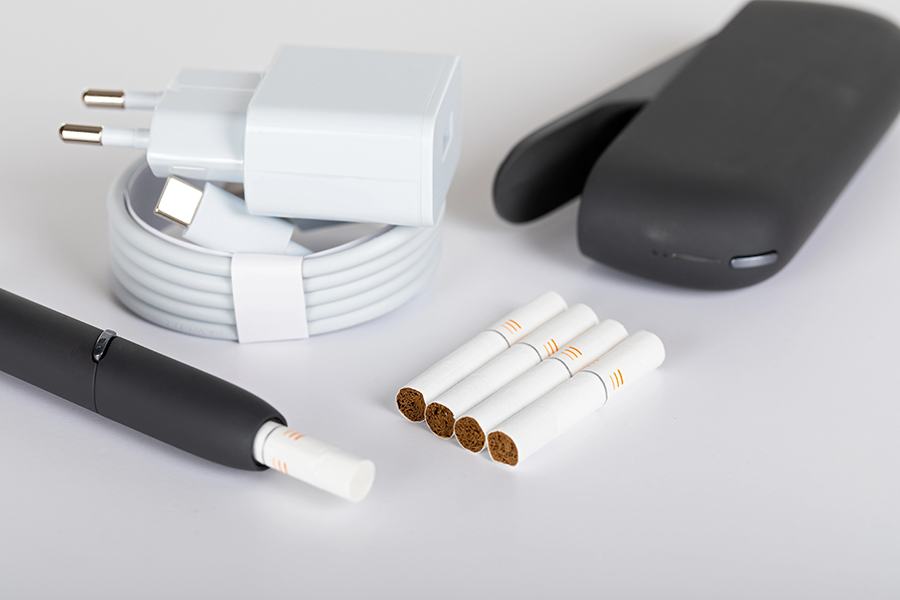
Heated tobacco products (HTP) are electronic devices that consist of a battery and a heating element, and they use proprietary (own brand) sticks of solid tobacco. These tobacco sticks are inserted into the device before being electronically heated to release nicotine vapour that can be inhaled in a similar way to vaping. Unlike combustible tobacco products, such as cigarettes and cigars, HTP do not burn tobacco – instead they heat it below its combustion point to release nicotine without igniting it.
Because of the high cost involved in developing and producing these products, it is typically only the tobacco industry that has the capability and resources to invest in the research, development and production of HTP. And, due to the individual design of each brand of HTP, the tobacco sticks are exclusive to each make. For example, the heat sticks for IQOS products – known as HEETS – are not compatible with Ploom, which uses its own EVO sticks.
Initial attempts to create a HTP in the 1980s were widely panned, with poor flavour contributing to consumer dislike of the products.[1] The first modern HTP, called IQOS, was brought to market by Philip Morris in 2014.[2]
Are heated tobacco products safer than high-risk combustible tobacco products?
Most of the studies analysing the effects of HTP have been conducted by manufacturers, but there is a growing body of independent research on HTP and more than 400 non-industry studies have been published since 2024. A number of important factors support their use as a safer alternative to smoking.
Combustible cigarettes burn tobacco at more than 800°C, producing in excess of 4,000 chemical products, including at least 70 known carcinogens, that are inhaled by the user. Half of these chemical compounds are produced by combustion alone, and are not present in raw tobacco leaf.[3] This cocktail of harmful chemicals found in tobacco smoke is directly tied to the substantial health impacts associated with cigarettes, with smoking directly contributing to 80%–90% of all lung cancer deaths.[4]
most of the studies analysing the effects of HTP have been conducted by manufacturers, but there is a growing body of independent research on HTP and more than 400 nonindustry studies have been published since 2024
In contrast, HTP use an electronic heating element to heat tobacco to approximately 350°C.[5] This vaporises a number of compounds including nicotine, without causing the tobacco to burn. By heating tobacco to release nicotine, but not burning it, it has been proposed that HTP may avoid producing many of the toxic byproducts created by the combustion of tobacco in cigarettes.
In contrast to other safer nicotine products, such as nicotine vapes, there have been relatively fewer studies exploring the efficacy of HTP as a safer alternative to combustible tobacco use. However, some key research has shown that HTP expose the user to fewer toxic compounds compared to smoking. A 2022 Cochrane review, which is considered the gold standard for the assessment of research into the efficacy and safety of safer nicotine products, has stated that “There was moderate‐certainty evidence that heated tobacco users have lower exposure to toxicants/carcinogens than cigarette smokers.”[6]
A report from the UK’s Committee on Toxicity has also said: “As the exposure to compounds of concern in the aerosol is reduced compared to conventional cigarette smoke, it is likely that there is a reduction in risk, though not to zero, to health for smokers who switch completely to heat-not-burn tobacco products.”[7]
This underlines the harm reduction potential of HTP. Although they are not 100% risk free, HTP offer a safer alternative for people who smoke who are looking to quit and switch to these products.

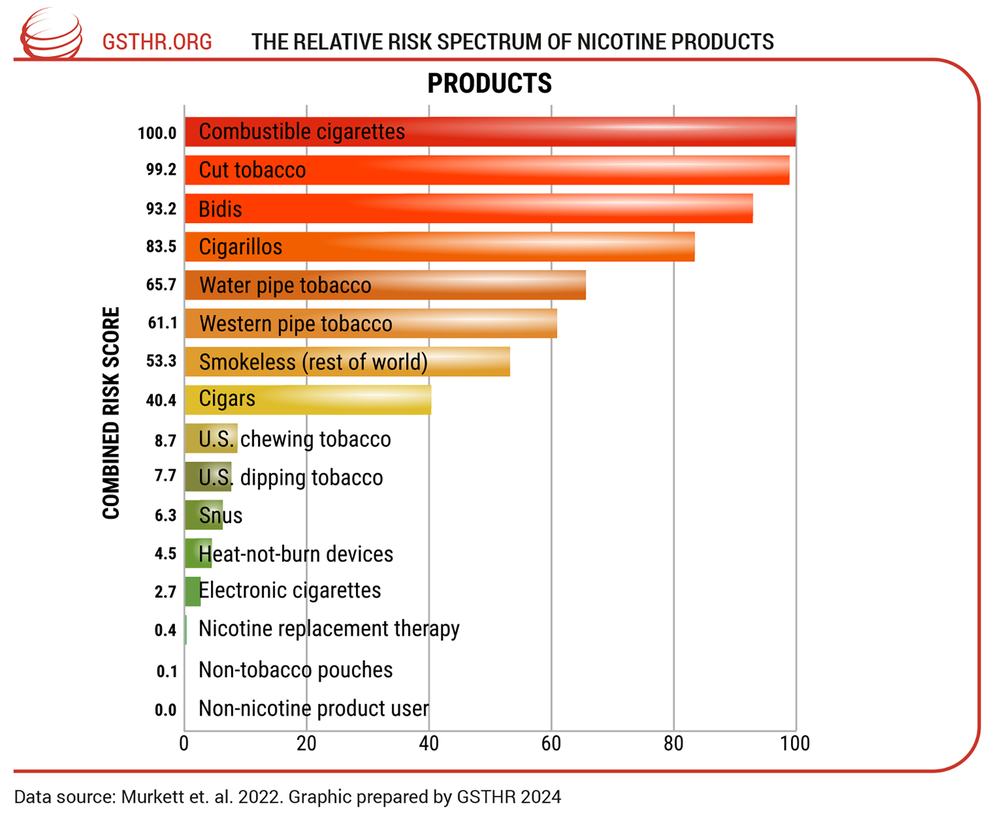
A 2022 evidence review carried out by Rachel Murkett and colleagues highlights the striking reduction in risk that HTP represent, when compared to tobacco smoking.[8] Figure 1 illustrates the relative risk of a variety of safer nicotine products, as well as high-risk tobacco products, with HTP lying between snus and vaping.
Figure 1
It is widely accepted that further studies are needed to establish the long-term effects of HTP, including more studies that are not funded by the tobacco industry. The Cochrane Review 2022 says: “We need more independently funded research into whether heated tobacco helps people stop smoking, whether it results in unwanted effects, and the impact of rising heated tobacco use on smoking rates.”[9]
Because the use of HTP still involves the heating of tobacco leaf, there are some compounds present in the nicotine vapour that increase the risk of harm relative to zero use of these products. These include tobacco-specific nitrosamines (TSNAs), a group of carcinogenic compounds also found in combustible tobacco smoke.[10] TSNAs have been detected in HTP but at significantly lower levels than in cigarette smoke.[11][12] Importantly, however, the weight of evidence indicates that the vapour produced by HTP is safer than the smoke produced by combustible tobacco products.
the weight of evidence indicates that the vapour produced by HTP is safer than the smoke produced by combustible tobacco products
Where and why are people taking up heated tobacco products?
Although relatively new, HTP have been steadily increasing in popularity across the globe. We estimate that 69 countries currently allow the sale of HTP.[13] In most of these countries, however, HTP are less popular than other safer nicotine products, such as vapes.
Data from the 2020 Eurobarometer survey of 28 European countries showed that the most common reason why people used HTP was the perception that they were safer than smoking (39.5% of HTP users).[14] Additionally, one out of every three HTP users surveyed reported that they used HTP to stop or reduce smoking. And, in Mexico, where HTP use prevalence is 1.1%, 40% of HTP users cited “lower perceived harm” as a key factor driving their use of the products.[15]
Key market data sheds some important light on the impact HTP are having on the sale of cigarettes. In markets where HTP are available and popular, a clear substitution effect is taking place. There are signs that consumers are swapping combustible cigarettes for less harmful HTP, driven in part by the high rates of taxation on combustible products compared to HTP in some markets.[16] HTP sales are even predicted to overtake cigarette sales in countries such as Lithuania and Hungary in the next few years, with consumers in these countries adopting HTP at a faster rate than Japan.[17]
we estimate that 69 countries currently allow the sale of HTP
HTP are the largest safer nicotine product category by market share, outcompeting even vapes.[18] This is mainly because HTP devices cost more than vapes, and it should be noted that more vapes are sold compared to HTP. But, in countries such as Japan, it is a very different story.
What can we learn from Japan?
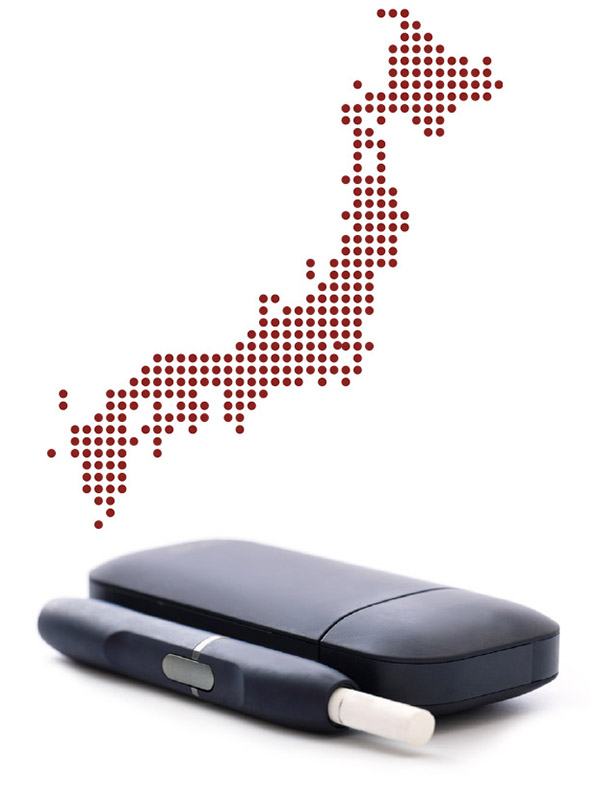
HTP are the most popular safer nicotine product in Japan, largely due to a facilitative regulatory environment when compared to other SNP. Arriving in Japan in 2014, HTP quickly rose in popularity, and their commercial success has been associated with the strong decline in smoking rates seen in the past decade. When HTP were introduced in 2014, 29.7% of men and 9.7% of women were smoking, a relatively high figure for a high-income country. Compare that to 2025, where smoking prevalence had fallen to 10.5%. Meanwhile 11.8% of Japanese adults were current users of HTP in 2025, which amounted to 12.9 million people.[19]
In contrast, only 2.1 million people in Japan were currently using nicotine vapes in 2025.[20] This is still a significant number of people, but is six times lower than the figure for HTP users, primarily due to the fact that vapes are banned (unless licensed as a medicinal product), while HTP can be legally bought online and in-store.
As the popularity of HTP has increased, Japanese consumers have bought fewer cigarettes. The UK’s Cochrane review has highlighted that the introduction, and rising use, of HTP in Japan is correlated with the decline in smoking rates seen in the country, with the fall in cigarette sales corresponding with an increase in sales of HTP.[21] A 2024 study has also highlighted the harm reduction potential for HTP in Japan – if 50% of Japan’s smoking population were to switch to HTP, the number of patients treated for smoking-related diseases could potentially decrease by 12 million people.[22]
Our own research has shown that cigarette sales in Japan have reduced by over 50% since the introduction of HTP. Check out our briefing paper Cigarette sales halved: heated tobacco products and the Japanese experience where we explore this topic in further detail.
How are heated tobacco products regulated around the world?
Ranging from full-scale bans to wide availability, and from strictly regulated to completely undefined in law, the global regulatory framework for HTP is inconsistent and highly dependent on local attitudes to safer nicotine products and their role in tobacco harm reduction. In total, 69 countries allow the sale of HTP,[23] while 26 countries such as Australia, China and Brazil have blanket bans on these products.[24] Some countries such as Japan place HTP in the same tax bracket as pipe tobacco, reinforcing the perception that HTP are not safer than cigarettes but still making them available for consumers to purchase.[25]
What have regulators and health bodies said about heated tobacco products?
Reflecting the patchy regulatory situation, opinion is divided among regulators and health bodies about HTP. For example, the World Health Organization has taken a hardline stance against HTP, classifying these safer nicotine products as tobacco products and therefore “inherently toxic”.[26] The EU’s Tobacco Products Directive (TPD) has likewise taken a precautionary stance on these products by banning all flavoured HTP.[27] It is likely that the EU will harden its stance on safer nicotine products including HTP in the next update to the TPD, which is expected to be finalized in the next couple of years.[28]
However, some health bodies have bucked the WHO’s stance. An evidence review conducted in 2018 by Public Health England (now The Office for Health Improvement and Disparities) found that HTP were likely significantly safer than combustible cigarettes, stating: “Compared with cigarette smoke, HTP are likely to expose users and bystanders to lower levels of particulate matter and harmful and potentially harmful compounds.”[29]
New Zealand’s government has also highlighted that “heated products are considered less harmful than smoked products due to the lack of products of combustion”, in a paper outlining proposed cuts to excise duty on HTP.[30] They also stated that HTP offer an alternative to vaping for people who smoke and are struggling to quit using vapes. New Zealand’s government has emphasised the role HTP could play in enabling New Zealand to reach its “Smokefree 2025” target.[31]
“Compared with cigarette smoke, HTP are likely to expose users and bystanders to lower levels of particulate matter and harmful and potentially harmful compounds”
In a landmark move in 2020, the Food and Drug Administration authorised that IQOS, an HTP produced by Philip Morris, could be marketed as a modified risk product, indicating that the product was less harmful than smoking.[32] A 2024 cross-sectional survey of 502 users of HTP assessed the impact of this product on the American market, finding that HTP use helped them to reduce or quit their cigarette intake.[33]
Can the success of HTP be repeated across lower- and middle-income countries?
While vapes are the most popular SNP globally, HTP are still the largest safer nicotine product category by overall market share. This is because these products are significantly more expensive than other safer nicotine products such as vapes or pouches. The cost of these products relative to combustible cigarettes is also a factor. In some high-income countries, HTP may be less expensive than some combustible cigarette brands, due to the higher taxation of combustible products compared to HTP. But in low- and middle-income countries, where the cost of combustible cigarettes can be relatively low, HTP can be significantly more expensive, at least initially. This is also the case when just looking at SNP because disposable vapes tend to be cheaper than the initial cost of buying a HTP device.
In our GSTHR Briefing Paper Safer nicotine product taxation and optimal strategies for public health, we showed that in 59 out of 65 countries analysed, HTP are taxed more favourably than combustible cigarettes. But why then are HTP typically more expensive than more harmful combustible products? This comes down to industry tactics – to drive up profit margins, tobacco companies push up the price of HTP, despite the lower tax burden placed on these products. This means that the lower tax rates on these products are generally not passed on to consumers. So, despite favourable taxation of these products, consumers do not see a knock-on benefit of reduced costs for HTP.
Key takeaways
Heated tobacco products have proved to be highly effective in replacing cigarette smoking in countries such as Japan, where vaping restrictions have helped to boost their appeal to consumers, so much so that heated tobacco products have now become the dominant safer nicotine product by market share. Their steady rise in popularity has helped shift people who smoke onto these less-harmful alternatives, with national public health bodies citing these products as playing a role to help reduce smoking rates. Influential public health research such as the Cochrane Review 2022 have widely agreed that heated tobacco products expose users to lower levels of key toxins and carcinogens than are otherwise found in combustible tobacco smoke. Yet there is still opposition to this key safer nicotine product due to the relative lack of independent research into their safety, and the difficulty in separating these products from the devastating impact of combustible tobacco use. With some regulators looking to tighten restrictions on the sale of these products, their future, as with some other safer nicotine products, is uncertain. But the real-world impact of these products in helping reduce cigarette consumption highlights their potential to play a key role in tobacco harm reduction efforts across the globe.
with some regulators looking to tighten restrictions on the sale of these products, their future, as with some other safer nicotine products, is uncertain
For further information about the Global State of Tobacco Harm Reduction’s work, or the points raised in this GSTHR Briefing Paper, please contact [email protected]
About us: Knowledge·Action·Change (K·A·C) promotes harm reduction as a key public health strategy grounded in human rights. The team has over forty years of experience of harm reduction work in drug use, HIV, smoking, sexual health, and prisons. K·A·C runs the Global State of Tobacco Harm Reduction (GSTHR) which maps the development of tobacco harm reduction and the use, availability and regulatory responses to safer nicotine products, as well as smoking prevalence and related mortality, in over 200 countries and regions around the world. For all publications and live data, visit https://gsthr.org
Our funding: The GSTHR project is produced with the help of a grant from Global Action to End Smoking (formerly known as Foundation for a Smoke-Free World), an independent, US non-profit 501(c)(3) grant-making organisation, accelerating science-based efforts worldwide to end the smoking epidemic. Global Action played no role in designing, implementing, data analysis, or interpretation of this Briefing Paper. The contents, selection, and presentation of facts, as well as any opinions expressed, are the sole responsibility of the authors and should not be regarded as reflecting the positions of Global Action to End Smoking.
[1] ‘Safer’ Cigarettes: A History. (2001, October 2). https://www.pbs.org/wgbh/nova/article/safer-cigarettes-history/.
[2] The History of IQOS Heated Tobacco Products | IQOS UK. (n.d.). IQOS. Retrieved 11 February 2026, from https://www.iqos.com/gb/en/blog/history-of-iqos-heated-tobacco-products.html.
[3] Engstrom, P. F., Clapper, M. L., & Schnoll, R. A. (2003). Physiochemical Composition of Tobacco Smoke. In Holland-Frei Cancer Medicine. 6th edition. BC Decker. https://www.ncbi.nlm.nih.gov/books/NBK13173/.
[4] CDC. (2025, February 13). Lung Cancer Risk Factors. Lung Cancer. https://www.cdc.gov/lung-cancer/risk-factors/index.html.
[5] Whiteside, E. (2019, February 1). Smokeless tobacco: 5 common questions about ‘heat not burn’ products answered. Cancer Research UK - Cancer News. https://news.cancerresearchuk.org/2019/02/01/smokeless-tobacco-5-common-questions-about-heat-not-burn-products-answered/.
[6] Tattan-Birch, H., Hartmann-Boyce, J., Kock, L., Simonavicius, E., Brose, L., Jackson, S., Shahab, L., & Brown, J. (2022). Heated tobacco products for smoking cessation and reducing smoking prevalence. Cochrane Database of Systematic Reviews, 1. https://doi.org/10.1002/14651858.CD013790.pub2.
[7] COMMITTEE ON TOXICITY, COMMITTEE ON CARCINOGENICITY, & COMMITTEE ON MUTAGENICITY OF CHEMICALS IN FOOD, CONSUMER PRODUCTS AND THE ENVIRONMENT. (n.d.). Statement on the toxicological evaluation of novel heat- not-burn tobacco products. Retrieved 12 September 2025, from https://cot.food.gov.uk/sites/default/files/heat_not_burn_tobacco_statement.pdf?
[8] Murkett, R., Rugh, M., & Ding, B. (2022). Nicotine products relative risk assessment: An updated systematic review and meta-analysis. F1000Research. https://doi.org/10.12688/f1000research.26762.2.
[9] Tattan-Birch, Hartmann-Boyce, Kock, Simonavicius, Brose, Jackson, Shahab, & Brown, 2022.
[10] Leigh, N. J., Page, M. K., Robinson, D. L., Heldwein, S. D., O’Connor, R. J., & Goniewicz, M. L. (2024). Nicotine, Humectants, and Tobacco-Specific Nitrosamines (TSNAs) in IQOS Heated Tobacco Products (HTPs): A Cross-Country Study. Toxics, 12(3), 180. https://doi.org/10.3390/toxics12030180.
[11] Leigh, N. J., Palumbo, M. N., Marino, A. M., O’Connor, R. J., & Goniewicz, M. L. (2018). Tobacco-specific nitrosamines (TSNA) in heated tobacco product IQOS. Tobacco Control, 27(Suppl 1), s37–s38. https://doi.org/10.1136/tobaccocontrol-2018-054318.
[12] Wang, H.-T., Wang, P.-H., Chen, C.-Y., Liu, T.-Y., & Tsou, H.-H. (2025). Comparison of carbonyls and tobacco-specific nitrosamines in aerosols of heated tobacco products and conventional cigarette smoke using both targeted and untargeted analytical methods. Regulatory Toxicology and Pharmacology, 157, 105786. https://doi.org/10.1016/j.yrtph.2025.105786.
[13] Which countries allow the sale of heated tobacco products. (n.d.-a). Global State of Tobacco Harm Reduction. Retrieved 12 February 2026, from https://gsthr.org/faq-smoking-and-nicotine/heated-tobacco-products/which-countries-allow-the-sale-of-heated-tobacco-products/.
[14] Laverty, A. A., Vardavas, C. I., & Filippidis, F. T. (2021). Prevalence and reasons for use of Heated Tobacco Products (HTP) in Europe: An analysis of Eurobarometer data in 28 countries. The Lancet Regional Health - Europe, 8, 100159. https://doi.org/10.1016/j.lanepe.2021.100159.
[15] Cruz-Jimenez, L., Barrientos-Gutiérrez, I., Zavala-Arciniega, L., Arillo-Santillán, E., Gallegos-Carrillo, K., Rodríguez-Bolaños, R., Gravely, S., & Thrasher, J. F. (2022). Heated tobacco product use, its correlates, and reasons for use among Mexican smokers. Drug and Alcohol Dependence, 232, 109283. https://doi.org/10.1016/j.drugalcdep.2022.109283.
[16] Do, V. V., Shang, C., Huang, J., Islam, T., Pechacek, T. F., & Weaver, S. R. (2025). Volumetric choice experiment to estimate the impact of e-cigarette and heated tobacco product characteristics on substitution and complementary use among adults who smoke cigarettes and recently initiated e-cigarette use. BMJ Open, 15(7), e100073. https://doi.org/10.1136/bmjopen-2025-100073.
[17] The Global State of Tobacco Harm Reduction 2024: A Situation Report. (n.d.). Global State of Tobacco Harm Reduction. Retrieved 12 February 2026, from https://gsthr.org/resources/thr-reports/the-global-state-of-tobacco-harm-reduction-2024-a-situation-report/.
[18] The Global State of Tobacco Harm Reduction 2024, n.d.
[19] Smoking, vaping, HTP, NRT and snus in Japan. (n.d.). Global State of Tobacco Harm Reduction. Retrieved 16 February 2026, from https://gsthr.org/countries/profile/jpn/.
[20] E-cigarette vaping in Japan. (n.d.). Global State of Tobacco Harm Reduction. Retrieved 12 February 2026, from https://gsthr.org/countries/profile/jpn/e_cigarettes/.
[21] Tattan-Birch, Hartmann-Boyce, Kock, Simonavicius, Brose, Jackson, Shahab, & Brown, 2022.
[22] Mahlich, J., & Kamae, I. (2024). Switching from Cigarettes to Heated Tobacco Products in Japan—Potential Impact on Health Outcomes and Associated Health Care Costs. Healthcare, 12(19), 1937. https://doi.org/10.3390/healthcare12191937.
[23] Which countries allow the sale of heated tobacco products. (n.d.-b). Global State of Tobacco Harm Reduction. Retrieved 12 February 2026, from https://gsthr.org/faq-smoking-and-nicotine/heated-tobacco-products/which-countries-allow-the-sale-of-heated-tobacco-products/.
[24] Which countries ban the sale of heated tobacco products? (n.d.). Global State of Tobacco Harm Reduction. Retrieved 12 February 2026, from https://gsthr.org/faq-smoking-and-nicotine/heated-tobacco-products/which-countries-ban-the-sale-of-heated-tobacco-products/.
[25] Using HTP in Japan. (n.d.). Global State of Tobacco Harm Reduction. Retrieved 12 February 2026, from https://gsthr.org/countries/profile/jpn/htp/.
[26] Heated tobacco products: Information sheet. (n.d.). Retrieved 12 February 2026, from https://www.who.int/publications/i/item/WHO-NMH-PND-17.6.
[27] The EU’s Tobacco Products Directive: Revisiting the Requirements and Updates on Heated Tobacco Products. (2023, February 10). Keller and Heckman. https://www.khlaw.com/insights/eus-tobacco-products-directive-revisiting-requirements-and-updates-heated-tobacco-products.
[28] Revision of the Tobacco Taxation Directive (proposal)—Taxation and Customs Union. (n.d.). Retrieved 12 February 2026, from https://taxation-customs.ec.europa.eu/taxation/excise-duties/excise-duties-tobacco/revision-tobacco-taxation-directive-proposal_en.
[29] Evidence review of e-cigarettes and heated tobacco products 2018: Executive summary. (n.d.). GOV.UK. Retrieved 12 February 2026, from https://www.gov.uk/government/publications/e-cigarettes-and-heated-tobacco-products-evidence-review/evidence-review-of-e-cigarettes-and-heated-tobacco-products-2018-executive-summary.
[30] Cabinet and briefing material: Heated tobacco products | Ministry of Health NZ. (2024, August 29). https://www.health.govt.nz/information-releases/cabinet-and-briefing-material-heated-tobacco-products.
[31] Cabinet and briefing material, 2024.
[32] Products, C. for T. (2025). Philip Morris Products S.A. Modified Risk Tobacco Product (MRTP) Applications. FDA. https://www.fda.gov/tobacco-products/advertising-and-promotion/philip-morris-products-sa-modified-risk-tobacco-product-mrtp-applications.
[33] Noggle, B., Ball, K. M., & Vansickel, A. R. (2024). A reduced exposure heated tobacco product was introduced then abruptly taken off United States shelves: Results from a tobacco harm reduction natural experiment. Harm Reduction Journal, 21(1), 84. https://doi.org/10.1186/s12954-024-01000-2.
Images: depositphotos.com