The legal availability of safer nicotine products (SNPs) is an important condition for tobacco harm reduction (THR), but availability in itself is not enough. People who smoke must also be able to afford them. When cigarettes remain substantially cheaper than nicotine vapes, heated tobacco products (HTPs) or nicotine pouches, the financial incentive is pointing consumers in the wrong direction: to sustained smoking. This Briefing Paper reveals a divide between richer and poorer countries in the affordability of safer alternatives – and what it means for global progress on reducing smoking.
How does price influence tobacco and nicotine use?
Price and affordability are well established determinants of tobacco consumption, particularly among price-sensitive consumers.[1] Consumer prices reflect manufacturers’ pricing strategies, retail margins, competition and government taxation. Governments have long used tobacco taxation as a key policy tool to raise cigarette prices, as part of efforts to reduce smoking. In a harm reduction context, however, relative prices also matter because cigarettes and SNPs compete with one another. For someone deciding whether to continue smoking, switch products or use nicotine for the first time, the relevant question is not simply whether an alternative to combustible cigarettes exists, but what it costs in comparison.
The recently published Global State of Tobacco Harm Reduction 2026: A Situation Report examined this question using new cross-country price data.[2] It found a striking divide: in high-income countries (HICs), several SNP categories are competitively priced against cigarettes, while in low- and middle-income countries (LMICs), cigarettes frequently remain the cheaper option. Taking action to address this disparity could significantly accelerate global progress in reducing the burden of death and disease caused by smoking. This is because around 80% of the world’s population who smoke live in LMICs.
Earlier GSTHR work examined how taxation can be structured to encourage switching towards lower-risk products.[3] This newer evidence allows us to look beyond tax rates to the outcome that ultimately matters to consumers: whether switching is actually affordable and financially attractive. In practice, that depends on several things – the price of an SNP relative to cigarettes, the share of income required to buy it and any additional product or device costs.
for someone deciding whether to continue smoking, switch products or use nicotine for the first time, the relevant question is not simply whether an alternative to combustible cigarettes exists, but what it costs in comparison
The analysis covers several SNP categories, but the more detailed affordability comparisons focus mainly on HTPs because comparable cross-country data are more consistently available. For vaping products and nicotine pouches, differences in product format, nicotine strength, pack or liquid size, hardware requirements and promotional pricing make like-for-like comparisons more difficult. Price and tax data are also less consistently reported across countries, limiting robust comparisons of affordability and tax burdens.
The global price divide
There is a stark difference between richer and poorer countries in the affordability of safer alternatives compared to cigarettes. Our research shows that in LMICs, pod-based nicotine vapes cost approximately 3.2 times as much as the cheapest cigarettes, disposable vapes around 2.5 times as much, and HTPs around 2.3 times as much. Nicotine-containing e-liquid for open-system vapes is the main exception, approaching price parity with the cheapest cigarettes.[4,5]
there is a stark difference between richer and poorer countries in the affordability of safer alternatives compared to cigarettes
By contrast, safer alternatives are sold at prices broadly equivalent to, or less than, cigarettes in most HICs. Disposable vapes cost around 1.4 times the cheapest cigarette brand and are priced similarly to the most-sold cigarette brand. Vape pods cost about 1.2 times the cheapest brand and 0.8 times the most-sold brand. HTPs are priced at approximately 1.2 and 0.9 times these respective cigarette benchmarks, while open-system e-liquid costs only around one-fifth as much as cigarettes.
Looking across individual countries reinforces the disparity. Disposable nicotine vapes or vape pods are priced below the cheapest cigarette brand in only 20–30% of LMICs. No LMIC had HTPs priced below the cheapest cigarette brand, and HTPs were cheaper than the most-sold cigarette brand in only around one-quarter of LMICs.
Recent evidence on HTPs shows the same price divide. A 2026 cross-country study covering 55 countries found HTP sticks were more expensive than the most-sold cigarette brand in 23 countries and more expensive than the cheapest brand in 44. In all nine lower-middle-income countries in the sample, HTPs were more expensive than the most-sold cigarettes, as they were in 10 of 16 upper-middle-income countries. In contrast, they were cheaper than the most-sold brand in 24 of 30 HICs. No low-income country in the study had an HTP market at all.[6]

Figure 1
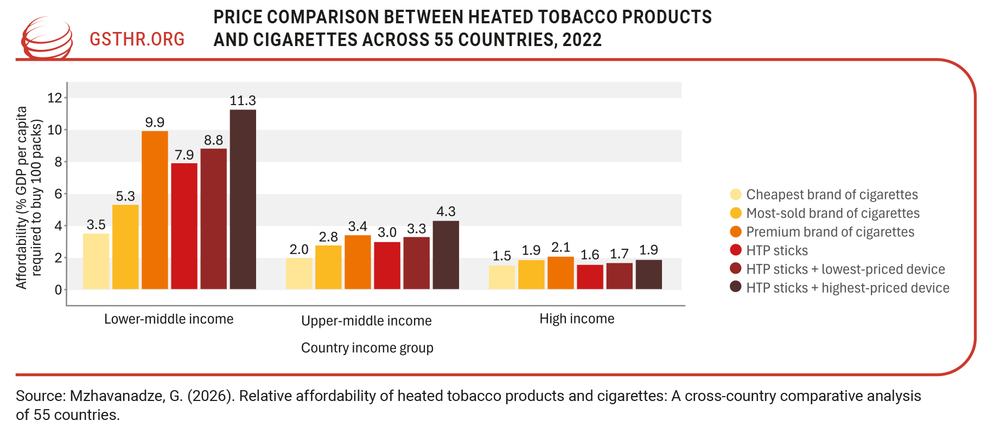
The price divide matters because around four in five people who smoke live in LMICs. This means that in many of the countries with the greatest need for safer alternatives to smoking, the price structure is working against substitution rather than encouraging it.
The figures also show why legal availability alone is an inadequate measure of access. A product can be on the market, acceptable to consumers and potentially capable of replacing cigarettes, but still remain beyond the realistic budget of many people who smoke.
in many of the countries with the greatest need for safer alternatives to smoking, the price structure is working against substitution rather than encouraging it
Price is not the same as affordability
Comparing retail prices tells only part of the story. For consumers, affordability means the price of a product relative to their income. Products can also become more expensive in cash terms but more affordable if incomes rise even faster.
WHO estimates that, between 2014 and 2024, cigarettes became significantly less affordable in only 46 countries. There was no appreciable trend in 92 countries. Meanwhile, cigarettes actually became more affordable in 42 countries.[7]
The more detailed HTP data show how lower incomes can magnify these price differences. The study measures affordability using the cost of purchasing 100 packs of HTP sticks or cigarettes, expressed as a percentage of GDP per capita (a country’s annual economic output per person). This provides a standardised measure for comparing affordability across countries. In lower-middle-income countries, buying 100 packs of HTP sticks cost the equivalent of 7.9% of GDP per capita compared with 5.3% for the most-sold cigarettes and 3.5% for the cheapest cigarettes. In HICs, the corresponding figures were 1.6%, 1.9% and 1.5%.[8]
The same inequality appears within countries. For people in the lowest income quintile – the lowest 20% by income – purchasing 100 HTP packs represented 9.1% of annual income, compared with 7.9% for the most-sold cigarette brand. For the highest income quintile, the respective figures were only 1.4% and 1.3%. Device costs can widen the difference further: including the heating device increased estimated annual HTP expenditure by 9.2–35.3%, depending on the device.
A price difference that is almost irrelevant to a wealthy consumer can therefore be a substantial obstacle to harm reduction for someone living on a much lower income.
a price difference that is almost irrelevant to a wealthy consumer can be a substantial obstacle to harm reduction for someone living on a much lower income
Lower taxes do not guarantee lower prices
Taxation remains one of the most important tools governments have for changing the relative prices of nicotine products. A 2025 GSTHR Briefing Paper, Safer nicotine product taxation and optimal strategies for public health, argued for tax structures that preserve a substantial price advantage for lower-risk products relative to combustible cigarettes.[9]
But a lower tax rate does not automatically produce a lower consumer price. The 55-country HTP study found that tax accounted for a smaller share of the price of HTPs than cigarettes in many countries, yet this advantage did not consistently translate into lower retail prices.[10]
The reason is that taxes are only one part of the final price. Manufacturer pricing, retail margins, competition and product positioning all matter. A government can therefore give an SNP a tax advantage without guaranteeing that the full benefit reaches people who smoke.

Nor is the relationship between tax and retail price necessarily one-for-one. A 2026 systematic review of nicotine vape taxation found large differences in ‘tax pass-through’ – the extent to which a tax change is reflected in the price paid by consumers. Estimates ranged from 0.07 to 1.67. In some markets, businesses absorbed much of the tax; in others, retail prices increased by more than the tax itself.[11]
Tax policy still matters, but tax rates should not be treated as the final measure of whether fiscal policy supports THR. The relevant outcome is the relative retail price and affordability faced by the consumer.
tax policy still matters, but tax rates should not be treated as the final measure of whether fiscal policy supports THR
Relative prices can change what people use
This matters because cigarettes and SNPs are part of the same market. Changes in the price of one product can affect demand for another.
Evidence from several product categories shows how this can work. A cross-country study of cigarettes and HTPs found HTP demand to be considerably more sensitive to price than cigarette demand. A 10% increase in HTP prices was associated with an estimated 12–13% reduction in demand, compared with around 3% for cigarettes. The study also found that HTP demand increased when cigarette prices rose, although cigarette demand did not respond significantly to changes in HTP prices.[12]
the study found that HTP demand increased when cigarette prices rose, although cigarette demand did not respond significantly to changes in HTP prices
More recent evidence from South Korea, where cigarettes, HTPs and nicotine vapes are all widely used, points in a similar direction. Nicotine vapes were the most price-sensitive product. Higher vape prices were associated with spending shifting towards conventional cigarettes, while HTP demand was particularly responsive to income.[13] US retail data provide evidence from another product category: a 10% increase in nicotine pouch prices was associated with a 2.3% fall in pouch sales in convenience stores. Conversely, higher cigarette taxes were associated with increased pouch sales.[14]
Experimental evidence points in the same direction. In a discrete choice experiment, adults who smoked were presented with hypothetical choices between cigarettes, nicotine vapes and quitting both products under different price and regulatory scenarios. When vape prices increased, respondents shifted mainly towards combustible cigarettes rather than towards quitting nicotine altogether.[15]
The policy lesson is that a change in the use of one nicotine product cannot be evaluated in isolation. If a policy makes an SNP less attractive, what matters is not only whether use of that product falls, but what people choose instead.
if a policy makes an SNP less attractive, what matters is not only whether use of that product falls, but what people choose instead
Affordability is an equity issue
The global price divide creates a clear inequality in access to THR. In richer countries, high cigarette prices often allow SNPs to compete effectively with cigarettes. In many poorer countries, inexpensive cigarettes remain the benchmark while newer, safer alternatives enter the market at a premium. People living in those countries therefore face a very different set of economic choices.
The HTP evidence shows that the inequality continues within national markets. Lower income groups devote a much greater proportion of their resources to the same products, and the relative disadvantage of HTPs compared with cigarettes is greatest among those with the least income.[16]
This creates a situation in which people with greater financial resources can choose from a growing range of non-combustible products, while consumers with lower incomes – including those in wealthier countries – may still face a market in which cigarettes remain the most affordable option.
Making the safer choice the affordable choice
The objective of a responsible, THR-oriented fiscal policy would not simply be to make all safer nicotine products cheap. Instead, it should be to create price structures that offer people who smoke a meaningful financial reason to move away from combustion.
Achieving this requires two complementary objectives. First, cigarettes should become progressively less affordable over time relative to consumers’ incomes. Tax increases that merely keep pace with inflation may be insufficient where real incomes are rising; WHO’s decade-long data illustrate why affordability, rather than price alone, needs to be monitored.[17] This also requires effective measures against illicit cigarette trade, which can undermine tax-induced price increases.
differentiated taxation can help preserve a financial incentive to switch, particularly where cigarettes and SNPs function as substitutes
Although price differences may create incentives for illicit trade, its scale also depends on governance, tax administration and enforcement. Second, taxation of SNPs should not eliminate their relative price advantage. Differentiated taxation can help preserve a financial incentive to switch, particularly where cigarettes and SNPs function as substitutes.
However, taxation is only one part of the picture. Preferential tax treatment for SNPs is intended to create a financial incentive for people who smoke to switch. But manufacturers are commercial businesses, with strong incentives to protect their margins. Numerous tobacco companies present their SNP brands as part of a transition away from the business of selling cigarettes, with the ambition to reduce harm to consumers central to this change. Yet their pricing strategies are often working against these stated objectives: they are using favourable tax treatment for SNPs to sustain higher margins, rather than ensure lower consumer prices.[18,19]
This disparity is especially stark in lower income markets. Aspirations to shift business away from cigarettes are expressed in global terms. But the price evidence shows that SNPs are much less competitively priced against combustibles in LMICs than in HICs. In practice, this has created a gap between rhetoric and the commercial reality faced by consumers in poorer countries, where switching is often considerably less affordable. At the same time, combustible cigarettes continue to generate substantial profits for major tobacco companies, with some maintaining or increasing earnings from these products even as cigarette volumes decline.

This raises an uncomfortable question about how strongly commercial incentives are aligned with stated goals to accelerate the transition away from smoking. Governments cannot assume that a tax advantage will be passed through to consumers. As discussed in our earlier Briefing Paper, options include making preferential tax treatment conditional on maintaining a meaningful price advantage over cigarettes, imposing price ceilings or profit margin caps, promoting greater competition in SNP markets, and using targeted subsidies to reduce switching costs.[20] Each approach involves trade-offs, but the central principle is straightforward: tax advantages intended to support harm reduction must primarily benefit consumers, not producers.
the price evidence shows that SNPs are much less competitively priced against combustibles in LMICs than in HICs
Policy evaluation should also track what consumers do after prices change. A reduction in use of a particular SNP cannot automatically be treated as a public health gain if some consumers respond by continuing or returning to cigarette smoking.
Conclusion
THR depends on people moving away from combustible cigarettes. Access, risk perception, product acceptability and regulation all matter, but affordability can determine whether switching is realistic in everyday life.
The evidence reveals a substantial global imbalance. In many HICs, safer alternatives can compete with cigarettes on price and often cost substantially less. In many LMICs, the opposite is true. Cigarettes are cheap, while SNPs frequently carry a substantial premium. Income makes that divide wider.
Products that are easily affordable in wealthy countries can consume a significant share of income elsewhere, particularly among lower income households. Upfront device costs can create an additional barrier to switching.
affordability can determine whether switching away from cigarettes is realistic
Taxation is only part of the solution. Just as higher taxes do not always translate one-for-one into retail price increases, the lower tax rates applied to SNPs are not always guaranteeing lower consumer prices. Companies are not consistently passing SNP tax advantages through to consumers.
Ultimately, what matters is the financial incentive facing the person deciding whether to continue smoking or move to something less harmful. Recent evidence also reinforces why that incentive matters. Cigarettes, nicotine vapes, HTPs and nicotine pouches, all compete with one another, although the strength of substitution varies across markets. Policy therefore affects not only how much nicotine people consume, but which products they use.
Product availability is necessary for THR, but it is not sufficient. Four out of five people who smoke live in LMICs. But it is in these countries where harm reduction is the furthest from reach, as safer alternatives are often much less affordable relative to cigarettes than in high income economies. If the most harmful nicotine product is also the cheapest, then the incentive structure is pointing people in the wrong direction.
if the most harmful nicotine product is also the cheapest, then the incentive structure is pointing people in the wrong direction
For further information about the Global State of Tobacco Harm Reduction’s work, or the points raised in this GSTHR Briefing Paper, please contact [email protected]
About us: Knowledge•Action•Change (K•A•C)promotes harm reduction as a key public health strategy grounded in human rights. The team has over forty years of experience of harm reduction work in drug use, HIV, smoking, sexual health, and prisons. K•A•C runs the Global State of Tobacco Harm Reduction (GSTHR) which maps the development of tobacco harm reduction and the use, availability and regulatory responses to safer nicotine products, as well as smoking prevalence and related mortality, in over 200 countries and regions around the world. For all publications and live data, visit https://gsthr.org
Our funding: The GSTHR project is produced with the help of a grant from the Global Action to End Smoking, Inc. (“Global Action”), a US nonprofit 501(c)(3) private foundation, accelerating science-based efforts worldwide to end the smoking epidemic. Global Action had no role in designing, implementing, data analysis, or interpretation of this Briefing Paper. The contents, selection and presentation of facts, as well as any opinions expressed herein, are the sole responsibility of the authors and under no circumstances should they be regarded as reflecting the positions of Global Action.
[1] Nargis, N., Stoklosa, M., Shang, C., & Drope, J. (2021). Price, Income, and Affordability as the Determinants of Tobacco Consumption: A Practitioner’s Guide to Tobacco Taxation. Nicotine & Tobacco Research, 23(1), 40–47. https://doi.org/10.1093/ntr/ntaa134.
[2] Shapiro, H., & Mzhavanadze, G. (2026). The Global State of Tobacco Harm Reduction 2026: A Situation Report (No. 5; GSTHR Major Reports). Global State of Tobacco Harm Reduction (GSTHR). https://gsthr.org/resources/thr-reports/the-global-state-of-tobacco-harm-reduction-2026-a-situation-report/.
[3] Mzhavanadze, G. (2025). Safer nicotine product taxation and optimal strategies for public health (GSTHR Briefing Papers). Global State of Tobacco Harm Reduction (GSTHR). https://gsthr.org/resources/briefing-papers/safer-nicotine-product-taxation-and-optimal-strategies-for-public-health/.
[4] Shapiro & Mzhavanadze, 2026.
[5] WHO. (2025). Tobacco MPOWER Raise taxes: Retail price for tobacco and nicotine products. The Global Health Observatory; World Health Organisation. https://www.who.int/data/gho/data/indicators/indicator-details/GHO/tobacco-raise-taxes--retail-price-for-and-nicotine-products.
[6] Mzhavanadze, G. (2026). Relative affordability of heated tobacco products and cigarettes: A cross-country comparative analysis of 55 countries. Harm Reduction Journal, 23(1), 151. https://doi.org/10.1186/s12954-026-01509-8.
[7] World Health Organization. (2025). WHO report on the global tobacco epidemic, 2025: Warning about the dangers of tobacco (No. 978-92-4-011206–3). World Health Organization. https://www.who.int/publications/i/item/9789240112063.
[8] Mzhavanadze, 2026.
[9] Mzhavanadze, 2025.
[10] Mzhavanadze, 2026.
[11] Wang, Q., Zhu, Z., Gong, C., Lv, Y., Qin, Y., Zhang, Y., Fu, Y., Zhang, J., Song, Y., Jiang, Y., & Yang, L. (2026). The impact of e-cigarette taxation: A systematic review and meta-analysis on usage, pricing strategies, and public health implications. BMC Medicine, 24(1), 92. https://doi.org/10.1186/s12916-026-04633-1.
[12] Dauchy, E., & Shang, C. (2024). The price elasticity of heated tobacco and cigarette demand: Empirical evaluation across countries. Health Economics, 33(12), 2708–2722. https://doi.org/10.1002/hec.4888.
[13] Choi, E. C., Kim, J., & Lee, S. (2026). Cross-price elasticities of cigarettes, heated tobacco products and e-cigarettes in South Korea: Evidence for tobacco tax policy design. Tobacco Control. https://doi.org/10.1136/tc-2025-059774.
[14] He, Y., Zhang, Z., Keller-Hamilton, B., Roberts, M. E., Mays, D., Wagener, T. L., Berman, M. L., & Shang, C. (n.d.). How the sales of oral nicotine pouches correlate with prices and respond to taxes on cigarettes and e-cigarettes. Addiction, n/a(n/a). https://doi.org/10.1111/add.70237.
[15] Kenkel, D., Mathios, A., Phillips, G., Surya Narayana, R., Wang, H., & Zeng, S. (2026). The Impact of Tobacco Regulations on Smoking and Vaping. Southern Economic Journal, 92(4), 956–972. https://doi.org/10.1002/soej.70019.
[16] Mzhavanadze, 2026.
[17] World Health Organization, 2025.
[18] Mzhavanadze, 2026.
[19] Wang, Zhu, Gong, Lv, Qin, Zhang, Fu, Zhang, Song, Jiang, & Yang, 2026.
[20] Mzhavanadze, 2025.
Photos: depositphotos.com