- Cigarettes remain the cheapest nicotine product in LMICs, but in HICs safer products often cost the same or less as cigarettes;
- Manufacturers share ambitions to move away from cigarettes, but commercial rhetoric does not match consumer reality in poorer countries;
- The affordability gap is also present within countries, impacting people on lower incomes who tend to have higher rates of smoking;
- Harm reduction’s global potential rests on safer products being both available and affordable in comparison to cigarettes.
Today the Global State of Tobacco Harm Reduction (GSTHR) has published its latest Briefing Paper The price of switching: when safer nicotine products cost more than cigarettes, which quantifies a stark affordability gap between richer and poorer countries. In low- and middle-income countries (LMICs), safer nicotine products usually cost more than cigarettes. In high income countries (HICs), safer products often cost the same or less.
Tobacco consumption patterns are strongly affected by price and affordability, particularly among budget-conscious consumers. Many people find it hard to stop using nicotine, even though they know smoking is bad for their health. Nicotine vapes, pouches, snus or heated tobacco products (HTPs) offer people the choice of switching to a product that significantly lowers the health risks. But when cigarettes are the cheaper option, the financial incentive points towards the continued use of tobacco.
Global price disparity disadvantages poorer countries
In LMICs, pod vapes cost about 3.2x the price of the cheapest cigarettes, disposable vapes 2.5x the price and HTPs 2.3x the price of the cheapest cigarettes. No LMIC had HTPs priced below the cheapest cigarettes; only open-system vape e-liquid came close to price parity with cigarettes.
In contrast, safer products often cost the same as cigarettes or less in high income countries. Pod vapes cost about 1.2x the price of the cheapest brand of cigarettes and 0.8x the most sold brand.
Disposable vapes cost about 1.4x the price of the cheapest cigarette brand and were priced similarly to the most sold brand. HTPs are priced at approximately 1.2x the price of the cheapest cigarettes and 0.9 times the most sold brand. Open-system e-liquid costs around a fifth as much as cigarettes.
Product cost is only one part of the affordability picture
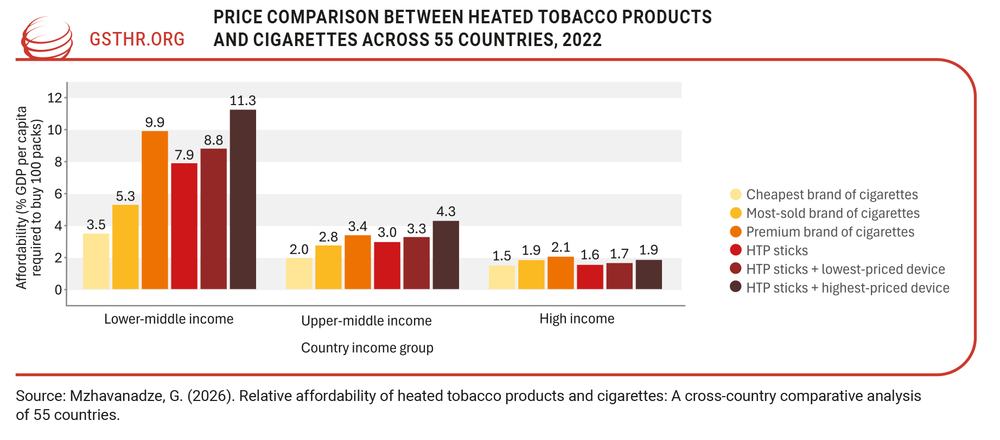
GSTHR research, published in Harm Reduction Journal, also concluded that the issue is replicated within as well as across countries. Lower incomes make the affordability gap wider still. The research considered the cost of purchasing 100 packs of cigarettes and the cost of purchasing 100 packs of HTP sticks, as this offers a more directly comparable measure than other safer product categories. This was then expressed as a percentage of GDP per capita.
In lower-middle-income countries, buying 100 packs of HTP sticks cost the equivalent of 7.9% of GDP per capita compared with 5.3% for the most-sold cigarettes, and 3.5% for the cheapest cigarettes. In HICs, buying 100 packs of HTP sticks cost the equivalent of 1.6% of GDP per capita compared with 1.9% for the most-sold cigarettes, and 1.5% for the cheapest cigarettes.
Within countries, the affordability gap was acute as well. People earning incomes in the lowest 20% would have to spend 9.1% of their annual income to buy 100 HTP packs, compared with 7.9% for the most sold cigarette brand. For those earning incomes in the highest 20%, these figures were just 1.4% and 1.3%. Including device costs could see the annual expenditure rise to as high as 35.3% of annual income.
Tax advantages and smoke-free goals: not for everyone?
Lower taxes on safer products are not a guarantee of lower prices at the counter, as some tax breaks on safer products are not being passed on to consumers. And while several manufacturers are sharing ambitions to transition away from cigarettes, the Briefing Paper argues that pricing strategies in poorer countries often work against this goal. Safer products are much less competitively priced against combustibles in LMICs than in HICs. This has led to a gap between the commercial rhetoric and the consumer reality in poorer countries, where switching to safer alternatives is considerably less affordable.
Giorgi Mzhavanadze, GSTHR Economist, said:
“When cigarettes are cheaper than lower-risk alternatives, people who smoke have less financial incentive to switch. With LMICs home to 4 in 5 people who smoke, affordability is putting harm reduction out of reach for the places and people that need it most. Manufacturers need to follow through on their ambitions to shift their businesses away from cigarettes for all consumers, in all countries – and along with governments, take action to ensure the less harmful alternative to smoking is the more affordable choice.”
Closing the affordability gap
The Briefing Paper calls for price structures that give people who smoke a meaningful financial incentive to switch, by making cigarettes steadily less affordable relative to incomes, tackling the illicit tobacco trade, ensuring a clear price advantage for safer products and making sure that any tax advantages benefit consumers not producers.
Notes
- The findings draw on The Global State of Tobacco Harm Reduction 2026: A Situation Report and a cross-country study of HTP affordability in 55 countries (Mzhavanadze, Harm Reduction Journal).
- The GSTHR project is produced with the help of a grant from the Global Action to End Smoking, Inc. (“Global Action”), a US nonprofit 501(c)(3) private foundation, accelerating science-based efforts worldwide to end the smoking epidemic. Global Action had no role in designing, implementing, data analysis, or interpretation of the Briefing Paper