

E-papierosy są legalne w Szwecji, gdzie zarówno sprzedaż internetowa, jak i w automatach jest dozwolona, a produkty dostępne są w ogólnodostępnych punktach handlowych. Zabronione jest jednak przypisywanie im właściwości zdrowotnych, a reklama podlega regulacjom. Akcyza na e-papierosy wynosi od 10% do 50% stawki obowiązującej dla tradycyjnych papierosów, co odzwierciedla umiarkowane podejście fiskalne w porównaniu do wyrobów tytoniowych. W Szwecji obowiązują liczne przepisy dotyczące e-papierosów, w tym wymóg zgłaszania nowych produktów, stosowanie opakowań zabezpieczonych przed dziećmi i ingerencją oraz umieszczanie ostrzeżeń zdrowotnych na opakowaniu. Minimalny wiek uprawniający do zakupu e-papierosów to 18 lat. Nie wprowadzono ograniczeń dotyczących dostępnych smaków, jednak zawartość nikotyny nie może przekraczać 20 mg/ml, a pojemność zbiornika nie może być większa niż 2 ml. Używanie e-papierosów podlega również ograniczeniom w miejscach publicznych. Statystyki pokazują, że w 2023 roku około 83 500 osób w Szwecji deklarowało korzystanie z e-papierosów. Szacuje się, że częstość używania e-papierosów wśród dorosłych wynosiła 1% w 2023 roku, przy czym w 2022 roku była nieco wyższa wśród kobiet (2,2%) niż mężczyzn (1,9%). W 2023 roku częstość codziennego używania e-papierosów wśród dorosłych wynosiła 0,6%. W 2022 roku codzienne używanie deklarowało 0,4% kobiet i 0,6% mężczyzn. W 2017 roku 65% dorosłych Szwedów uznawało e-papierosy za szkodliwe lub bardziej szkodliwe niż tradycyjne papierosy, 14% uznawało je za mniej szkodliwe, a 21% nie miało zdania na ten temat. Ogólnie rzecz biorąc, rynek e-papierosów w Szwecji cechuje się uregulowanym dostępem, umiarkowanym opodatkowaniem i stosunkowo niską popularnością, co wynika z silnie ugruntowanego przekonania o ryzyku zdrowotnym.
Częstość występowania
| Year | Value | Reference/Comment |
|---|---|---|
| 2018 | 2% | 2A A |
| 2021 | 1.1% | 2B |
| 2022 | 2% | 2C B |
| 2023 | 1% | 2D |
| 2024 | 4.9% | 2E |
- Public Health Agency. National Public Health Survey (tobacco/e-cigarette) 2018.
- European Commission. (2021). Special Eurobarometer 506: Attitudes of Europeans towards tobacco and electronic cigarettes (S2240_506_ENG). European Commission. http://data.europa.eu/88u/dataset/S2240_506_ENG
- WHO. WHO report on the global tobacco epidemic, 2023. Available at: https://cdn.who.int/media/docs/default-source/country-profiles/tobacco/gtcr-2023/tobacco-2023-swe.pdf?sfvrsn=25f02894_3&download=true. Accessed: 8 August 2025.
- European Commission. (2024). Special Eurobarometer 539: Attitudes of Europeans towards tobacco and related products [Dataset]. European Commission. https://europa.eu/eurobarometer/surveys/detail/2995
- Nationella folkhälsoenkäten 2024 cited in WHO. (2025). WHO global report on trends in prevalence of tobacco use 2000–2024 and projections 2025–2030 (6th edn). World Health Organization. https://www.who.int/publications/i/item/9789240116276
- n=40,000. 2% figure incldes daily users and occasional users. Age 16 - 84
- Adults survey: Nationella folkhälsoenkäten (National Survey on Public Health), 2022; National, ages 16-84
| Year | Value | Reference/Comment |
|---|---|---|
| 2022 | 2.2% | 2A A |
| 2024 | 5.5% | 2B |
- WHO. WHO report on the global tobacco epidemic, 2023. Available at: https://cdn.who.int/media/docs/default-source/country-profiles/tobacco/gtcr-2023/tobacco-2023-swe.pdf?sfvrsn=25f02894_3&download=true. Accessed: 8 August 2025.
- Nationella folkhälsoenkäten 2024 cited in WHO. (2025). WHO global report on trends in prevalence of tobacco use 2000–2024 and projections 2025–2030 (6th edn). World Health Organization. https://www.who.int/publications/i/item/9789240116276
- Adults survey: Nationella folkhälsoenkäten (National Survey on Public Health), 2022; National, ages 16-84
| Year | Value | Reference/Comment |
|---|---|---|
| 2022 | 1.9% | 2A A |
| 2024 | 4.5% | 2B |
- WHO. WHO report on the global tobacco epidemic, 2023. Available at: https://cdn.who.int/media/docs/default-source/country-profiles/tobacco/gtcr-2023/tobacco-2023-swe.pdf?sfvrsn=25f02894_3&download=true. Accessed: 8 August 2025.
- Nationella folkhälsoenkäten 2024 cited in WHO. (2025). WHO global report on trends in prevalence of tobacco use 2000–2024 and projections 2025–2030 (6th edn). World Health Organization. https://www.who.int/publications/i/item/9789240116276
- Adults survey: Nationella folkhälsoenkäten (National Survey on Public Health), 2022; National, ages 16-84
| Year | Value | Reference/Comment |
|---|---|---|
| 2022 | 41,494 | 3A A |
| 2023 | 50,096 | 3B B |
- 1. WHO. WHO report on the global tobacco epidemic, 2023. Available at: https://cdn.who.int/media/docs/default-source/country-profiles/tobacco/gtcr-2023/tobacco-2023-swe.pdf?sfvrsn=25f02894_3&download=true. Accessed: 8 August 2025. 2. Calculation based on population size data of people over 15 years of age (16+). Source of population data: World Population Prospects 2019 [Internet]. United Nations; 2019. (Department of Economic and Social Affairs, editor. Population Division). Report No.: Rev. 1. Available from: https://population.un.org/wpp/Download/Standard/Population/
- 1. European Commission. (2024). Special Eurobarometer 539: Attitudes of Europeans towards tobacco and related products [Dataset]. European Commission. https://europa.eu/eurobarometer/surveys/detail/2995 2. Calculation based on population size data of people over 15 years of age (16+). Source of population data: World Population Prospects 2019 [Internet]. United Nations; 2019. (Department of Economic and Social Affairs, editor. Population Division). Report No.: Rev. 1. Available from: https://population.un.org/wpp/Download/Standard/Population/
- Adults survey: Nationella folkhälsoenkäten (National Survey on Public Health), 2022; National, ages 16-84 World Population Prospects 2019 [Internet]. United Nations; 2019. (Department of Economic and Social Affairs, editor. Population Division). Report No.: Rev. 1. Available from: https://population.un.org/wpp/Download/Standard/Population/
- E-cigarettes with nicotine World Population Prospects 2019 [Internet]. United Nations; 2019. (Department of Economic and Social Affairs, editor. Population Division). Report No.: Rev. 1. Available from: https://population.un.org/wpp/Download/Standard/Population/
| Year | Value | Reference/Comment |
|---|---|---|
| 2022 | 0.5% | 4A A |
| 2023 | 0.6% | 4B B |
- WHO. WHO report on the global tobacco epidemic, 2023. Available at: https://cdn.who.int/media/docs/default-source/country-profiles/tobacco/gtcr-2023/tobacco-2023-swe.pdf?sfvrsn=25f02894_3&download=true. Accessed: 8 August 2025.
- European Commission. (2024). Special Eurobarometer 539: Attitudes of Europeans towards tobacco and related products [Dataset]. European Commission. https://europa.eu/eurobarometer/surveys/detail/2995
- Adults survey: Nationella folkhälsoenkäten (National Survey on Public Health), 2022; National, ages 16-84
- E-cigarettes with nicotine
- European Commission. (2021). Special Eurobarometer 506: Attitudes of Europeans towards tobacco and electronic cigarettes (S2240_506_ENG). European Commission. http://data.europa.eu/88u/dataset/S2240_506_ENG
- Nationella folkhälsoenkäten 2024 cited in WHO. (2025). WHO global report on trends in prevalence of tobacco use 2000–2024 and projections 2025–2030 (6th edn). World Health Organization. https://www.who.int/publications/i/item/9789240116276
- 1. European Commission. (2024). Special Eurobarometer 539: Attitudes of Europeans towards tobacco and related products [Dataset]. European Commission. https://europa.eu/eurobarometer/surveys/detail/2995 2. Calculation based on population size data of people over 15 years of age (16+). Source of population data: World Population Prospects 2019 [Internet]. United Nations; 2019. (Department of Economic and Social Affairs, editor. Population Division). Report No.: Rev. 1. Available from: https://population.un.org/wpp/Download/Standard/Population/
- European Commission. (2024). Special Eurobarometer 539: Attitudes of Europeans towards tobacco and related products [Dataset]. European Commission. https://europa.eu/eurobarometer/surveys/detail/2995
- WHO. WHO report on the global tobacco epidemic, 2023. Available at: https://cdn.who.int/media/docs/default-source/country-profiles/tobacco/gtcr-2023/tobacco-2023-swe.pdf?sfvrsn=25f02894_3&download=true. Accessed: 8 August 2025.
- E-cigarettes with nicotine World Population Prospects 2019 [Internet]. United Nations; 2019. (Department of Economic and Social Affairs, editor. Population Division). Report No.: Rev. 1. Available from: https://population.un.org/wpp/Download/Standard/Population/
- E-cigarettes with nicotine
- Adults survey: Nationella folkhälsoenkäten (National Survey on Public Health), 2022; National, ages 16-84
Promocja produktu
| Year | Value | Reference/Comment |
|---|---|---|
| 2017 or earlier | Tak | A |
| 2023 | Tak | 2A |
- Tobacco Control Laws. Legislation by Country/Jurisdiction Sweden. Available at: https://www.tobaccocontrollaws.org/legislation/sweden/e-cigarettes?row=1370870. Accessed: 24 July 2025.
- Allowed or banned at place of sale or allowed or banned in all media.
- Anti Smoking Global Index. Vaping Products. Available at: https://antismoking.global/world-map. Accessed: 22 July 2025.
- Tobacco Control Laws. Legislation by Country/Jurisdiction Sweden. Available at: https://www.tobaccocontrollaws.org/legislation/sweden/e-cigarettes?row=1370870. Accessed: 24 July 2025.
Regulacje
| Year | Value | Reference/Comment |
|---|---|---|
| 2017 or earlier | Dozwolone | 1A |
| 2024 | Dozwolone | 1B |
- Data cross-referenced where possible using the following sources :1. Vapetrotter website. Available at: https://www.vapetrotter.com/laws/ ; 2. Global tobacco control website. Available at:https://www.globaltobaccocontrol.org/node/14052 ; 3. Tobacco Control Laws website. Available at : https://www.tobaccocontrollaws.org/legislation/
- Anti Smoking Global Index. Vaping Products. Available at: https://antismoking.global/world-map. Accessed: 22 July 2025.
- Anti Smoking Global Index. Vaping Products. Available at: https://antismoking.global/world-map. Accessed: 22 July 2025.
- Data cross-referenced where possible using the following sources :1. Vapetrotter website. Available at: https://www.vapetrotter.com/laws/ ; 2. Global tobacco control website. Available at:https://www.globaltobaccocontrol.org/node/14052 ; 3. Tobacco Control Laws website. Available at : https://www.tobaccocontrollaws.org/legislation/
Dostępność
- Tobacco Control Laws. Legislation by Country/Jurisdiction Sweden. Available at: https://www.tobaccocontrollaws.org/legislation/sweden/e-cigarettes?row=1370870. Accessed: 24 July 2025.
- Anti Smoking Global Index. Vaping Products. Available at: https://antismoking.global/world-map. Accessed: 22 July 2025.
Regulacje i ograniczenia
| Year | Value | Reference/Comment |
|---|---|---|
| 2016 | Tak: 18 lat | 3A |
| 2021 | Tak: 18 lat | 3B |
- https://ec.europa.eu/health/tobacco/products/revision_en
- Global Tobacco Control. Country Laws Regulating E-Cigarettes. Available at: https://www.globaltobaccocontrol.org/en/policy-scan/e-cigarettes/countries?country=140. Accessed: 5 August 2025.
- Tobacco Control Laws. Legislation by Country/Jurisdiction Sweden. Available at: https://www.tobaccocontrollaws.org/legislation/sweden/e-cigarettes?row=1370870. Accessed: 24 July 2025.
- Anti Smoking Global Index. Vaping Products. Available at: https://antismoking.global/world-map. Accessed: 22 July 2025.
- Global Tobacco Control. Country Laws Regulating E-Cigarettes. Available at: https://www.globaltobaccocontrol.org/en/policy-scan/e-cigarettes/countries?country=140. Accessed: 5 August 2025.
- Text health warnings are required.
Postrzeganie szkodliwości
- Reference: European Commission (2017). Special Eurobarometer 458: Attitudes of Europeans towards tobacco and electronic cigarettes Available at: http://data.europa.eu/euodp/en/data/dataset/S2146_87_1_458_ENG
- Question asked in this survey did not compare harmfulness with cigarettes. The question used was 'Do you think they are harmful to the health of people who use them?' 65% - YES, 14% - NO, 21% DON'T KNOW
Podatek
- Anti Smoking Global Index. Vaping Products. Available at: https://antismoking.global/world-map. Accessed: 22 July 2025.
Publikacje

Legal Status of Snus
- Burning Issues: The Global State of Tobacco Harm Reduction 2020
Passed in 2001, the Tobacco Products Directive (TPD) was the first major European legislation specifically related to tobacco products. It is the only example of a regional approach to regulation. All EU member states must implement TPD into national Legislation.
Nearly a decade before, the first attack on what turned out to be a significant SNP was the EU-wide ban on the sale of snus in 1992, as a response to the attempt by the US Smokeless Tobacco Company to introduce oral Skoal Bandits into the UK. When Sweden joined the EU in 1995, snus was already in widespread use there and so was exempted from the ban.
In the years subsequent to TPD enactment, EU Commission reports identified new tobacco-related products which might be controlled to ensure conformity with EU harmonisation policies, noting increasing discrepancies between member states. As the sale of vaping devices was growing throughout the EU, member states were seeking advice and clarification from the Commission. In 2012, the Health and Consumer Directorate produced a proposal for the revision of the 2001 TPD whereby products with a nicotine content over a certain level – including most vaping products on the market – would have to be authorised as medicines. When the proposal came before the EU Parliament in 2013, numerous amendments to the Article were proposed, including one that all vaping products could only be sold as medicines under pharmaceutical regulations. Major objections from vapers via their EU political representatives helped derail this idea. In 2016, a revised TPD known as TPD2 came into force.
TPD2 regulates tobacco product manufacture, sale, distribution and advertising in the European Union covering vaping and HTP – with limitations on nicotine content and liquid bottle size – while reaffirming the ban on snus. Currently TPD2 is under review, with the report and possible proposals due out in May 2021.
See also p.119 of the report: Burning Issues: The Global State of Tobacco Harm Reduction 2020


The European Union (EU) Tobacco Products Directive (TPD) 2016 Changes to the EU TPD
- No Fire, No Smoke: The Global State of Tobacco Harm Reduction
The TPD is a Directive of the EU which means that all EU countries must ‘transpose’ or incorporate the TPD requirements into their national laws. The only flexibility permitted is the ability to enact additional regulations. The current Directive entered into force on 19th May 2014 and became applicable in the EU Member States on 20th May 2016.
In 2014 a revised Tobacco Products Directive known as TPD 2 was issued by the EU to update the 2001 Tobacco Products Directive. TPD2 regulates all tobacco products in the European Union and its scope is wide. It covers product regulation in terms of reporting obligations of ingredients and emissions for all tobacco products. It includes product packaging and labelling including the size and appearance of products, traceability features to be fixed onto packaging as well as health warnings. It covers cross-border advertising of tobacco products; it reinforces the ban on oral tobacco products (snus), but importantly it provides for the placing on the market of e-cigarettes and refill containers, as well as making provision for notification of novel tobacco products. It also provides for herbal cigarettes.
See also p. 96 of the report: No Fire, No Smoke: The Global State of Tobacco Harm Reduction 2018 — Global State of Tobacco Harm Reduction (gsthr.org)
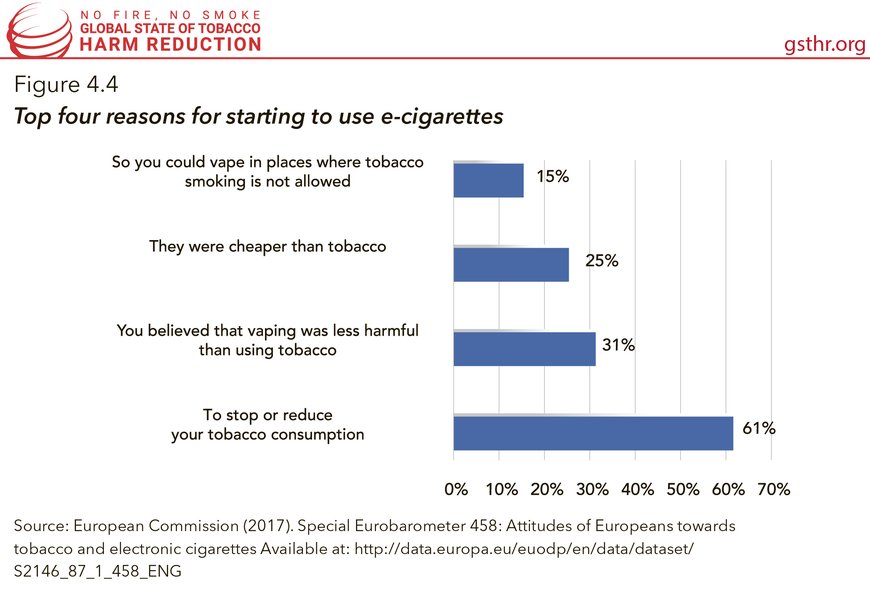
Top Four Reasons for Starting to Use E-Cigarettes
- No Fire, No Smoke: The Global State of Tobacco Harm Reduction
This figure illustrates the most important reasons that motivate smokers to switch to e-cigarettes, across the 28 member states of the European Union in 2017.
The top reason across the EU for using e-cigarettes is to stop using tobacco. The clear majority of people using e-cigarettes did so to stop, or to reduce tobacco use (61%). Following this the next reason was because they thought e-cigarettes were less harmful than cigarettes (31%), or less expensive (25%). Only 6% said they started because they felt using e-cigarettes was cool or attractive.
See also p. 44 of the report: No Fire, No Smoke: The Global State of Tobacco Harm Reduction 2018 — Global State of Tobacco Harm Reduction (gsthr.org)