

W Grecji stosowanie e-papierosów jest dozwolone. Kraj wprowadził kompleksowe przepisy regulujące produkcję i sprzedaż e-papierosów. W ramach tych regulacji dozwolona jest sprzedaż internetowa, a e-papierosy są dostępne w ogólnej sieci detalicznej na terenie całego kraju. Oświadczenia zdrowotne dotyczące używania e-papierosów są dozwolone pod określonymi warunkami, pod warunkiem zgodności z obowiązującymi przepisami. Obowiązują ograniczenia w reklamie, aby zapobiec działaniom promocyjnym. Na produkty związane z e-papierosami nałożona jest akcyza w wysokości do 10% podatków nakładanych na tradycyjne papierosy. Producenci i importerzy e-papierosów muszą zgłaszać nowe produkty odpowiednim organom przed wprowadzeniem ich na rynek. Opakowania muszą zawierać ostrzeżenia zdrowotne, a wszystkie pojemniki powinny być zabezpieczone przed dziećmi i odporne na manipulację. Ponadto sprzedaż dozwolona jest wyłącznie osobom powyżej 18. roku życia, lecz nie ma ograniczeń dotyczących dostępnych smaków. Maksymalne dopuszczalne stężenie nikotyny wynosi 20 mg/ml, a pojemność zbiornika jest ograniczona do 2 ml lub mniej, zgodnie z przepisami UE. W 2023 roku w Grecji odnotowano około 176 800 aktualnych użytkowników e-papierosów. Szacowana rozpowszechnienie używania e-papierosów wśród dorosłych wyniosła 2%, a codzienne używanie w tej grupie – 1,6% w 2023 roku. Dla porównania, w 2017 roku 27% dorosłych deklarowało, że przynajmniej raz spróbowało e-papierosów. Dane dotyczące opinii publicznej zebrane również w 2017 roku pokazały, że 65% respondentów uznało e-papierosy za szkodliwe lub bardziej szkodliwe od tradycyjnych papierosów, 19% uznało je za mniej szkodliwe, a 16% nie miało zdania.
Częstość występowania
| Year | Value | Reference/Comment |
|---|---|---|
| 2017 | 5% | 2A A |
| 2019 | 2.9% | 2B B |
| 2021 | 2.07% | 2C |
| 2023 | 2% | 2D |
| 2023 | 2% | 2E |
- Farsalinos K. Siakas G. Poulas K. Voudris V. Merakou K.and Barbouni A. (2018). Electronic cigarette use in Greece: an analysis of a representative population sample in Attica prefecture. Harm Reduction Journal. 15:20 Available at: https://harmreductionjournal.biomedcentral.com/articles/10.1186/s12954-018-0229-7
- WHO. WHO report on the global tobacco epidemic, 2023. Available at: https://cdn.who.int/media/docs/default-source/country-profiles/tobacco/gtcr-2023/tobacco-2023-deu.pdf?sfvrsn=3c353f56_3&download=true. Accessed: 7 August 2025.
- European Commission. (2021). Special Eurobarometer 506: Attitudes of Europeans towards tobacco and electronic cigarettes (S2240_506_ENG). European Commission. http://data.europa.eu/88u/dataset/S2240_506_ENG
- European Commission. (2024). Special Eurobarometer 539: Attitudes of Europeans towards tobacco and related products [Dataset]. European Commission. https://europa.eu/eurobarometer/surveys/detail/2995
- Eurobarometer 539 2023 cited in WHO. (2025). WHO global report on trends in prevalence of tobacco use 2000–2024 and projections 2025–2030 (6th edn). World Health Organization. https://www.who.int/publications/i/item/9789240116276
- This was a cross-sectional survey of a representative sample of 4058 adults (aged 18+) living in Attica prefecture (35% of the Greek adult population) which was conducted in May 2017 through telephone interviews. Prevalence and frequency of e-cigarette use were assessed according to the smoking status, and logistic regression analysis was performed to identify correlates of use.It should be noted that this is a regional prevalence survey not whole country. However Attica has 35% of the adult Greek population. Correspondence with the author explained the data on estimated number of vapers are extrapolated to the Attica population (1/3rd of the Greek population). But the prevalence (5% of the population) could be reasonably applicable to the whole population of Greece. This would mean there are about 450,000 vapers in Greece (in an adult population of about 9 million).
- Adults survey: Health Interview Survey, 2019; National, ages 15+
| Year | Value | Reference/Comment |
|---|---|---|
| 2019 | 160,422 | 3A A |
| 2023 | 141,459 | 3B B |
- 1. WHO. WHO report on the global tobacco epidemic, 2023. Available at: https://cdn.who.int/media/docs/default-source/country-profiles/tobacco/gtcr-2023/tobacco-2023-deu.pdf?sfvrsn=3c353f56_3&download=true. Accessed: 7 August 2025. 2. Calculation based on population size data of people over 15 years of age (16+). Source of population data: World Population Prospects 2019 [Internet]. United Nations; 2019. (Department of Economic and Social Affairs, editor. Population Division). Report No.: Rev. 1. Available from: https://population.un.org/wpp/Download/Standard/Population/
- 1. European Commission. (2024). Special Eurobarometer 539: Attitudes of Europeans towards tobacco and related products [Dataset]. European Commission. https://europa.eu/eurobarometer/surveys/detail/2995 2. Calculation based on population size data of people over 15 years of age (16+). Source of population data: World Population Prospects 2019 [Internet]. United Nations; 2019. (Department of Economic and Social Affairs, editor. Population Division). Report No.: Rev. 1. Available from: https://population.un.org/wpp/Download/Standard/Population/
- Adults survey: Health Interview Survey, 2019; National, ages 15+ World Population Prospects 2019 [Internet]. United Nations; 2019. (Department of Economic and Social Affairs, editor. Population Division). Report No.: Rev. 1. Available from: https://population.un.org/wpp/Download/Standard/Population/
- E-cigarettes with nicotine World Population Prospects 2019 [Internet]. United Nations; 2019. (Department of Economic and Social Affairs, editor. Population Division). Report No.: Rev. 1. Available from: https://population.un.org/wpp/Download/Standard/Population/
| Year | Value | Reference/Comment |
|---|---|---|
| 2019 | 1.8% | 4A A |
| 2023 | 1.6% | 4B B |
- WHO. WHO report on the global tobacco epidemic, 2023. Available at: https://cdn.who.int/media/docs/default-source/country-profiles/tobacco/gtcr-2023/tobacco-2023-deu.pdf?sfvrsn=3c353f56_3&download=true. Accessed: 7 August 2025.
- European Commission. (2024). Special Eurobarometer 539: Attitudes of Europeans towards tobacco and related products [Dataset]. European Commission. https://europa.eu/eurobarometer/surveys/detail/2995
- Adults survey: Health Interview Survey, 2019; National, ages 15+
- E-cigarettes with nicotine
- European Commission. (2021). Special Eurobarometer 506: Attitudes of Europeans towards tobacco and electronic cigarettes (S2240_506_ENG). European Commission. http://data.europa.eu/88u/dataset/S2240_506_ENG
- Eurobarometer 539 2023 cited in WHO. (2025). WHO global report on trends in prevalence of tobacco use 2000–2024 and projections 2025–2030 (6th edn). World Health Organization. https://www.who.int/publications/i/item/9789240116276
- 1. European Commission. (2024). Special Eurobarometer 539: Attitudes of Europeans towards tobacco and related products [Dataset]. European Commission. https://europa.eu/eurobarometer/surveys/detail/2995 2. Calculation based on population size data of people over 15 years of age (16+). Source of population data: World Population Prospects 2019 [Internet]. United Nations; 2019. (Department of Economic and Social Affairs, editor. Population Division). Report No.: Rev. 1. Available from: https://population.un.org/wpp/Download/Standard/Population/
- European Commission. (2024). Special Eurobarometer 539: Attitudes of Europeans towards tobacco and related products [Dataset]. European Commission. https://europa.eu/eurobarometer/surveys/detail/2995
- Farsalinos K. Siakas G. Poulas K. Voudris V. Merakou K.and Barbouni A. (2018). Electronic cigarette use in Greece: an analysis of a representative population sample in Attica prefecture. Harm Reduction Journal. 15:20 Available at: https://harmreductionjournal.biomedcentral.com/articles/10.1186/s12954-018-0229-7
- E-cigarettes with nicotine World Population Prospects 2019 [Internet]. United Nations; 2019. (Department of Economic and Social Affairs, editor. Population Division). Report No.: Rev. 1. Available from: https://population.un.org/wpp/Download/Standard/Population/
- E-cigarettes with nicotine
- This was a cross-sectional survey of a representative sample of 4058 adults (aged 18+) living in Attica prefecture (35% of the Greek adult population) which was conducted in May 2017 through telephone interviews. Prevalence and frequency of e-cigarette use were assessed according to the smoking status, and logistic regression analysis was performed to identify correlates of use.It should be noted that this is a regional prevalence survey not whole country. However Attica has 35% of the adult Greek population. Correspondence with the author explained the data on estimated number of vapers are extrapolated to the Attica population (1/3rd of the Greek population). But the prevalence (5% of the population) could be reasonably applicable to the whole population of Greece. This would mean there are about 450,000 vapers in Greece (in an adult population of about 9 million).
Promocja produktu
- Anti Smoking Global Index. Vaping Products. Available at: https://antismoking.global/world-map. Accessed: 22 July 2025.
- Allowed or banned at place of sale or allowed or banned in all media.
Regulacje
| Year | Value | Reference/Comment |
|---|---|---|
| 2017 or earlier | Dozwolone | 1A |
| 2024 | Dozwolone | 1B |
- Data cross-referenced where possible using the following sources :1. Vapetrotter website. Available at: https://www.vapetrotter.com/laws/ ; 2. Global tobacco control website. Available at:https://www.globaltobaccocontrol.org/node/14052 ; 3. Tobacco Control Laws website. Available at : https://www.tobaccocontrollaws.org/legislation/
- Anti Smoking Global Index. Vaping Products. Available at: https://antismoking.global/world-map. Accessed: 22 July 2025.
- Anti Smoking Global Index. Vaping Products. Available at: https://antismoking.global/world-map. Accessed: 22 July 2025.
- Data cross-referenced where possible using the following sources :1. Vapetrotter website. Available at: https://www.vapetrotter.com/laws/ ; 2. Global tobacco control website. Available at:https://www.globaltobaccocontrol.org/node/14052 ; 3. Tobacco Control Laws website. Available at : https://www.tobaccocontrollaws.org/legislation/
Dostępność
- Anti Smoking Global Index. Vaping Products. Available at: https://antismoking.global/world-map. Accessed: 22 July 2025.
Regulacje i ograniczenia
- Global Tobacco Control. Country Laws Regulating E-Cigarettes. Available at: https://www.globaltobaccocontrol.org/en/policy-scan/e-cigarettes/countries?country=89. Accessed: 24 July 2025.
- Anti Smoking Global Index. Vaping Products. Available at: https://antismoking.global/world-map. Accessed: 22 July 2025.
- https://ec.europa.eu/health/tobacco/products/revision_en
Postrzeganie szkodliwości
- Reference: European Commission (2017). Special Eurobarometer 458: Attitudes of Europeans towards tobacco and electronic cigarettes Available at: http://data.europa.eu/euodp/en/data/dataset/S2146_87_1_458_ENG
- Question asked in this survey did not compare harmfulness with cigarettes. The question used was 'Do you think they are harmful to the health of people who use them?' 65% - YES, 19% - NO, 16% DON'T KNOW
Podatek
- Anti Smoking Global Index. Vaping Products. Available at: https://antismoking.global/world-map. Accessed: 22 July 2025.
Publikacje

The European Union (EU) Tobacco Products Directive (TPD) 2016 Changes to the EU TPD
- No Fire, No Smoke: The Global State of Tobacco Harm Reduction
The TPD is a Directive of the EU which means that all EU countries must ‘transpose’ or incorporate the TPD requirements into their national laws. The only flexibility permitted is the ability to enact additional regulations. The current Directive entered into force on 19th May 2014 and became applicable in the EU Member States on 20th May 2016.
In 2014 a revised Tobacco Products Directive known as TPD 2 was issued by the EU to update the 2001 Tobacco Products Directive. TPD2 regulates all tobacco products in the European Union and its scope is wide. It covers product regulation in terms of reporting obligations of ingredients and emissions for all tobacco products. It includes product packaging and labelling including the size and appearance of products, traceability features to be fixed onto packaging as well as health warnings. It covers cross-border advertising of tobacco products; it reinforces the ban on oral tobacco products (snus), but importantly it provides for the placing on the market of e-cigarettes and refill containers, as well as making provision for notification of novel tobacco products. It also provides for herbal cigarettes.
See also p. 96 of the report: No Fire, No Smoke: The Global State of Tobacco Harm Reduction 2018 — Global State of Tobacco Harm Reduction (gsthr.org)

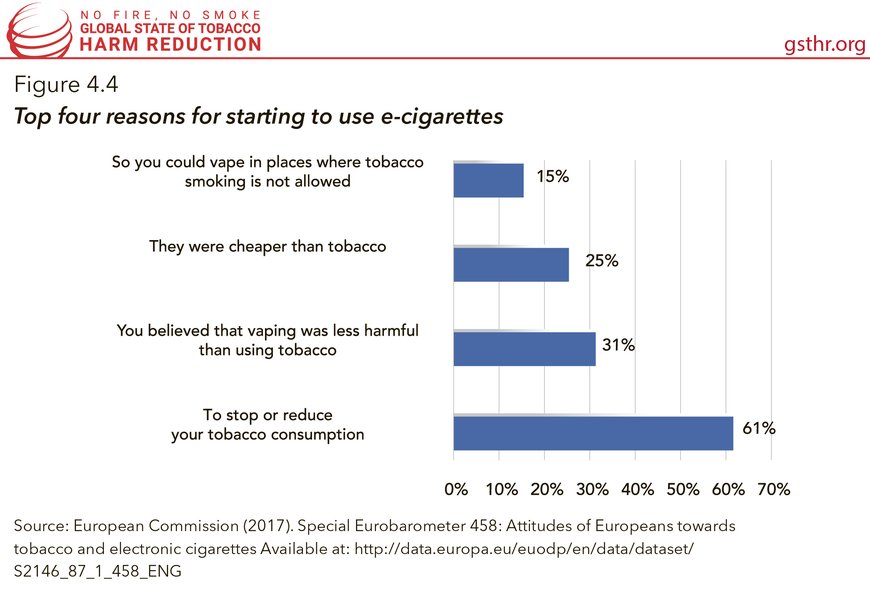
Top Four Reasons for Starting to Use E-Cigarettes
- No Fire, No Smoke: The Global State of Tobacco Harm Reduction
This figure illustrates the most important reasons that motivate smokers to switch to e-cigarettes, across the 28 member states of the European Union in 2017.
The top reason across the EU for using e-cigarettes is to stop using tobacco. The clear majority of people using e-cigarettes did so to stop, or to reduce tobacco use (61%). Following this the next reason was because they thought e-cigarettes were less harmful than cigarettes (31%), or less expensive (25%). Only 6% said they started because they felt using e-cigarettes was cool or attractive.
See also p. 44 of the report: No Fire, No Smoke: The Global State of Tobacco Harm Reduction 2018 — Global State of Tobacco Harm Reduction (gsthr.org)
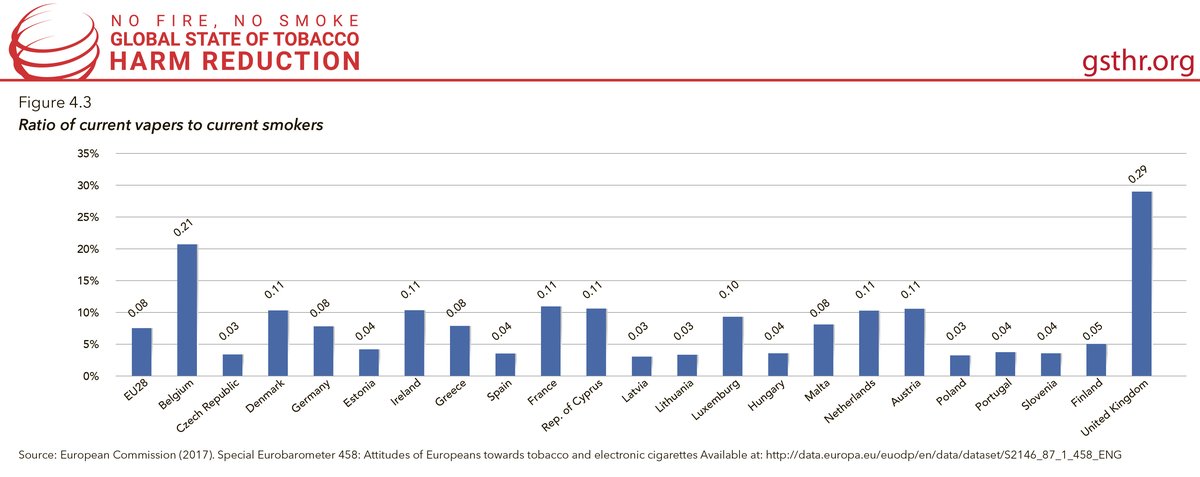
Ratio of Current Vapers to Current Smokers
- No Fire, No Smoke: The Global State of Tobacco Harm Reduction
This figure provides a simple metric giving the ratio of current e-cigarette users to current smokers amongst the 28 EU member states in 2017. This shows that the UK has the most e-cigarette users per smoker at 0.29. In other words, there are 29 e-cigarette users for every hundred smokers in the UK. In many other EU countries, the ratio is above 0.10.
These data were gathered by the European Union for the Eurobarometer 458 survey, which aimed to conduct an extensive survey of e-cigarette use across the EU as part of a wider review of smoking habits. Across the 28 EU member states this survey found that:
» Around 15 percent of those aged 15 or over had tried an e-cigarette at least once – compared to 12 percent in 2014;
» Two percent of the total EU population are current users of e-cigarettes and this has remained stable since 2014;
» Almost one in twenty current smokers now currently use e-cigarettes or similar devices (four percent), and four percent of ex-smokers;
» Current use of e-cigarettes among people who have never smoked is rare. At most, one percent of e-cigarette users in any EU country are people who have never smoked.
See also p. 42 of the report: No Fire, No Smoke: The Global State of Tobacco Harm Reduction 2018 — Global State of Tobacco Harm Reduction (gsthr.org)