

En Letonia, el uso de cigarrillos electrónicos está permitido, pero su venta se encuentra estrictamente regulada. No se permiten afirmaciones sobre beneficios para la salud relacionados con estos productos, y su publicidad está restringida por la legislación nacional. Los cigarrillos electrónicos pueden adquirirse en tiendas minoristas generales, pero no está permitido su venta en línea ni a través de máquinas expendedoras. El impuesto especial sobre los productos de cigarrillos electrónicos equivale al 10% de la tasa aplicable a los cigarrillos convencionales. Letonia aplica diversas regulaciones a estos productos: los nuevos deben notificarse antes de su comercialización y los envases deben incluir advertencias sanitarias. Los recipientes deben ser a prueba de niños y de manipulaciones indebidas, y existen límites tanto para la concentración de nicotina—máximo 20 mg/ml—como para la capacidad de los tanques, que no debe superar los 2 ml. Además, la venta está restringida a mayores de 18 años y no existen prohibiciones específicas sobre los sabores. El uso de cigarrillos electrónicos en determinados espacios públicos también está regulado. La percepción pública sobre los cigarrillos electrónicos en Letonia sigue siendo mayoritariamente negativa. En 2017, el 80% de los encuestados consideraba que los cigarrillos electrónicos eran igual de dañinos o más dañinos que los cigarrillos tradicionales, mientras que solo el 11% los veía como menos dañinos y el 9% no tenía opinión al respecto. En 2023 se estimaba que unas 120,700 personas en Letonia eran usuarias actuales de cigarrillos electrónicos, con una prevalencia de consumo adulto estimada en un 8%. Aproximadamente el 3.8% de los adultos declaró un uso diario y el 24% de los encuestados había probado los cigarrillos electrónicos al menos una vez.
Prevalencia
| Year | Value | Reference/Comment |
|---|---|---|
| 2017 | 1% | 2A A |
| 2020 | 2% | 2B B |
| 2021 | 1.95% | 2C |
| 2023 | 8% | 2D |
| 2023 | 8% | 2E |
- European Commission (2017). Special Eurobarometer 458: Attitudes of Europeans towards tobacco and electronic cigarettes Available at: http://data.europa.eu/euodp/en/data/dataset/S2146_87_1_458_ENG
- WHO. WHO report on the global tobacco epidemic, 2023. Available at: https://cdn.who.int/media/docs/default-source/country-profiles/tobacco/gtcr-2023/tobacco-2023-lva.pdf?sfvrsn=6e11f835_3&download=true. Accessed: 1 August 2025.
- European Commission. (2021). Special Eurobarometer 506: Attitudes of Europeans towards tobacco and electronic cigarettes (S2240_506_ENG). European Commission. http://data.europa.eu/88u/dataset/S2240_506_ENG
- European Commission. (2024). Special Eurobarometer 539: Attitudes of Europeans towards tobacco and related products [Dataset]. European Commission. https://europa.eu/eurobarometer/surveys/detail/2995
- Eurobarometer 539 2023 cited in WHO. (2025). WHO global report on trends in prevalence of tobacco use 2000–2024 and projections 2025–2030 (6th edn). World Health Organization. https://www.who.int/publications/i/item/9789240116276
- Eurobarometer data provides a representative sample of ~28,000 respondents and estimates the prevalence of vaping for the EU overall, as well as per country. The survey was conducted in March 2017. Covers 28 European Union (EU) countries. Total sample N = 27901, aged 15 and over.
- Adults survey: Health behaviour among Latvian adult population, 2020; National, ages 15-74

- European Commission. (2021). Special Eurobarometer 506: Attitudes of Europeans towards tobacco and electronic cigarettes (S2240_506_ENG). European Commission. http://data.europa.eu/88u/dataset/S2240_506_ENG
- Eurobarometer 539 2023 cited in WHO. (2025). WHO global report on trends in prevalence of tobacco use 2000–2024 and projections 2025–2030 (6th edn). World Health Organization. https://www.who.int/publications/i/item/9789240116276
- 1. European Commission. (2024). Special Eurobarometer 539: Attitudes of Europeans towards tobacco and related products [Dataset]. European Commission. https://europa.eu/eurobarometer/surveys/detail/2995 2. Calculation based on population size data of people over 15 years of age (16+). Source of population data: World Population Prospects 2019 [Internet]. United Nations; 2019. (Department of Economic and Social Affairs, editor. Population Division). Report No.: Rev. 1. Available from: https://population.un.org/wpp/Download/Standard/Population/
- European Commission. (2024). Special Eurobarometer 539: Attitudes of Europeans towards tobacco and related products [Dataset]. European Commission. https://europa.eu/eurobarometer/surveys/detail/2995
- European Commission (2017). Special Eurobarometer 458: Attitudes of Europeans towards tobacco and electronic cigarettes Available at: http://data.europa.eu/euodp/en/data/dataset/S2146_87_1_458_ENG
- E-cigarettes with nicotine World Population Prospects 2019 [Internet]. United Nations; 2019. (Department of Economic and Social Affairs, editor. Population Division). Report No.: Rev. 1. Available from: https://population.un.org/wpp/Download/Standard/Population/
- E-cigarettes with nicotine
- Eurobarometer data provides a representative sample of ~28,000 respondents and estimates the prevalence of vaping for the EU overall, as well as per country. The survey was conducted in March 2017. Covers 28 European Union (EU) countries. Total sample N = 27901, aged 15 and over.
Promoción de productos
| Year | Value | Reference/Comment |
|---|---|---|
| 2017 or earlier | Sí | A |
| 2021 | Sí | 2A |
- Tobacco Control Laws. Legislation by Country/Jurisdiction Latvia. Available at: https://www.tobaccocontrollaws.org/legislation/latvia/e-cigarettes?row=1218752. Accessed: 24 July 2025.
- Allowed or banned at place of sale or allowed or banned in all media.
- Anti Smoking Global Index. Vaping Products. Available at: https://antismoking.global/world-map. Accessed: 22 July 2025.
- Tobacco Control Laws. Legislation by Country/Jurisdiction Latvia. Available at: https://www.tobaccocontrollaws.org/legislation/latvia/e-cigarettes?row=1218752. Accessed: 24 July 2025.
Regulación
| Year | Value | Reference/Comment |
|---|---|---|
| 2017 or earlier | Permitidos | 1A |
| 2024 | Permitidos | 1B |
- Data cross-referenced where possible using the following sources :1. Vapetrotter website. Available at: https://www.vapetrotter.com/laws/ ; 2. Global tobacco control website. Available at:https://www.globaltobaccocontrol.org/node/14052 ; 3. Tobacco Control Laws website. Available at : https://www.tobaccocontrollaws.org/legislation/
- Anti Smoking Global Index. Vaping Products. Available at: https://antismoking.global/world-map. Accessed: 22 July 2025.
- Anti Smoking Global Index. Vaping Products. Available at: https://antismoking.global/world-map. Accessed: 22 July 2025.
- Data cross-referenced where possible using the following sources :1. Vapetrotter website. Available at: https://www.vapetrotter.com/laws/ ; 2. Global tobacco control website. Available at:https://www.globaltobaccocontrol.org/node/14052 ; 3. Tobacco Control Laws website. Available at : https://www.tobaccocontrollaws.org/legislation/
Disponibilidad
- Tobacco Control Laws. Legislation by Country/Jurisdiction Latvia. Available at: https://www.tobaccocontrollaws.org/legislation/latvia/e-cigarettes?row=1218752. Accessed: 24 July 2025.
- Anti Smoking Global Index. Vaping Products. Available at: https://antismoking.global/world-map. Accessed: 22 July 2025.
Regulaciones y restricciones
| Year | Value | Reference/Comment |
|---|---|---|
| 2024 | No | 4A |
| 2025 | Sí | 4B A |
- Anti Smoking Global Index. Vaping Products. Available at: https://antismoking.global/world-map. Accessed: 22 July 2025.
- Nordic Welfare
- From 1 Jan 2025, only tobacco flavor allowed in vaping products (all other flavors banned).. In force
- Tobacco Control Laws. Legislation by Country/Jurisdiction Latvia. Available at: https://www.tobaccocontrollaws.org/legislation/latvia/e-cigarettes?row=1218752. Accessed: 24 July 2025.
- Anti Smoking Global Index. Vaping Products. Available at: https://antismoking.global/world-map. Accessed: 22 July 2025.
- https://ec.europa.eu/health/tobacco/products/revision_en
- Nordic Welfare
- Global Tobacco Control. Country Laws Regulating E-Cigarettes. Available at: https://www.globaltobaccocontrol.org/en/policy-scan/e-cigarettes/countries?country=104. Accessed: 30 July 2025.
- From 1 Jan 2025, only tobacco flavor allowed in vaping products (all other flavors banned).. In force
Percepción del daño
- Reference: European Commission (2017). Special Eurobarometer 458: Attitudes of Europeans towards tobacco and electronic cigarettes Available at: http://data.europa.eu/euodp/en/data/dataset/S2146_87_1_458_ENG
- Question asked in this survey did not compare harmfulness with cigarettes. The question used was 'Do you think they are harmful to the health of people who use them?' 80% - YES, 11% - NO, 9% DON'T KNOW
Impuesto
- Anti Smoking Global Index. Vaping Products. Available at: https://antismoking.global/world-map. Accessed: 22 July 2025.
Publicaciones

The European Union (EU) Tobacco Products Directive (TPD) 2016 Changes to the EU TPD
- No Fire, No Smoke: The Global State of Tobacco Harm Reduction
The TPD is a Directive of the EU which means that all EU countries must ‘transpose’ or incorporate the TPD requirements into their national laws. The only flexibility permitted is the ability to enact additional regulations. The current Directive entered into force on 19th May 2014 and became applicable in the EU Member States on 20th May 2016.
In 2014 a revised Tobacco Products Directive known as TPD 2 was issued by the EU to update the 2001 Tobacco Products Directive. TPD2 regulates all tobacco products in the European Union and its scope is wide. It covers product regulation in terms of reporting obligations of ingredients and emissions for all tobacco products. It includes product packaging and labelling including the size and appearance of products, traceability features to be fixed onto packaging as well as health warnings. It covers cross-border advertising of tobacco products; it reinforces the ban on oral tobacco products (snus), but importantly it provides for the placing on the market of e-cigarettes and refill containers, as well as making provision for notification of novel tobacco products. It also provides for herbal cigarettes.
See also p. 96 of the report: No Fire, No Smoke: The Global State of Tobacco Harm Reduction 2018 — Global State of Tobacco Harm Reduction (gsthr.org)

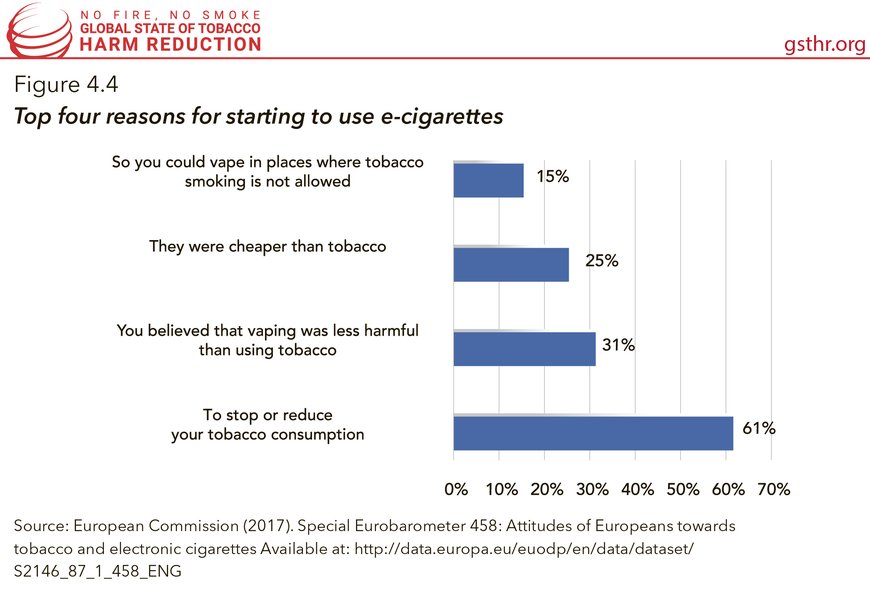
Top Four Reasons for Starting to Use E-Cigarettes
- No Fire, No Smoke: The Global State of Tobacco Harm Reduction
This figure illustrates the most important reasons that motivate smokers to switch to e-cigarettes, across the 28 member states of the European Union in 2017.
The top reason across the EU for using e-cigarettes is to stop using tobacco. The clear majority of people using e-cigarettes did so to stop, or to reduce tobacco use (61%). Following this the next reason was because they thought e-cigarettes were less harmful than cigarettes (31%), or less expensive (25%). Only 6% said they started because they felt using e-cigarettes was cool or attractive.
See also p. 44 of the report: No Fire, No Smoke: The Global State of Tobacco Harm Reduction 2018 — Global State of Tobacco Harm Reduction (gsthr.org)
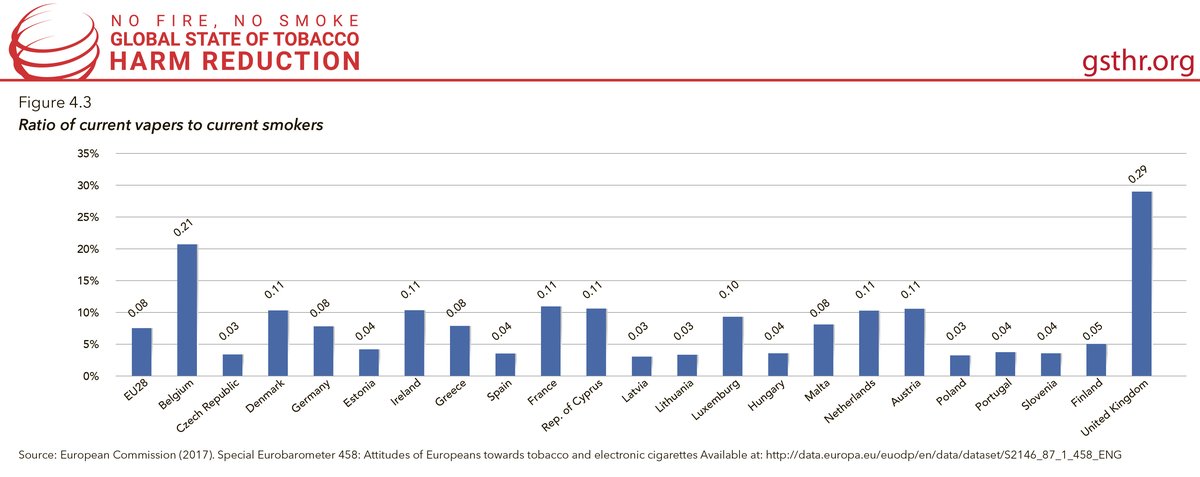
Ratio of Current Vapers to Current Smokers
- No Fire, No Smoke: The Global State of Tobacco Harm Reduction
This figure provides a simple metric giving the ratio of current e-cigarette users to current smokers amongst the 28 EU member states in 2017. This shows that the UK has the most e-cigarette users per smoker at 0.29. In other words, there are 29 e-cigarette users for every hundred smokers in the UK. In many other EU countries, the ratio is above 0.10.
These data were gathered by the European Union for the Eurobarometer 458 survey, which aimed to conduct an extensive survey of e-cigarette use across the EU as part of a wider review of smoking habits. Across the 28 EU member states this survey found that:
» Around 15 percent of those aged 15 or over had tried an e-cigarette at least once – compared to 12 percent in 2014;
» Two percent of the total EU population are current users of e-cigarettes and this has remained stable since 2014;
» Almost one in twenty current smokers now currently use e-cigarettes or similar devices (four percent), and four percent of ex-smokers;
» Current use of e-cigarettes among people who have never smoked is rare. At most, one percent of e-cigarette users in any EU country are people who have never smoked.
See also p. 42 of the report: No Fire, No Smoke: The Global State of Tobacco Harm Reduction 2018 — Global State of Tobacco Harm Reduction (gsthr.org)